Showing posts with label black oil sunflower. Show all posts

Friday, August 23, 2024

Summer Bird Feeding


Carolina chickadee
Most people don't feed birds (other than hummingbirds) in the summer, but I do. I get it. There is plenty of food available for the birds in the summer and quality bird food isn't cheap. But it's not about the birds, it's about me. I enjoy seeing the birds and having some food available brings the birds to me.

I do reduce the amount of food I provide. In the winter, I have 6 - 10 feeders out, depending upon the weather. In the summer, it's 2 - 4. 

To the left, you can see a Carolina chickadee at one of the feeders. If I have to choose just one feeder, it would be black oil sunflower in a wire tube feeder like this. Black oil sunflower is less expensive than most feed mixes and is enjoyed by almost all songbirds. In addition to chickadees, this feeder attracts cardinals, blue jays, house finches, common grackles, as well as house sparrows and starlings. I don't get many starlings, so it isn't a big deal for me. This feeder also attracts squirrels. You can see the feeders is bent up. That is courtesy of the squirrels. But the squirrels are fun also, and they aren't stealing food out of the birds' mouths, so it's all good.  I fill this feeder once a day in the summer. When its gone for the day, it's gone. The little moochers can go forage after that.

Peanuts for woodpeckers

My other favorite feeder is a heavier metal feeder that I fill with shelled peanuts. The chickadees also like this one, but I have it out mainly for the woodpeckers. I have downy woodpeckers, red-bellied woodpeckers, and occasionally, ladder-backed woodpeckers that visit the feeder every day. Blue jays, wrens, and starlings also are fond of this feeder. Shelled peanuts are expensive, but I use much less of this feed. What you see remaining in this feeder will last at least a week. Probably two. The squirrels don't bother this feeder--no idea why as they do like peanuts. Perhaps it's because this feeder is harder to get the peanuts out of and the feeder is much sturdier, making it harder to get open to pillage as they do the sunflower feeder.

I do throw a handful or two of mixed seed on the ground, more because it is amusing to watch the dogs go crazy than the birds it attracts (My husband calls this me "feeding the chickens" because of the way they go nuts.) Ground feeding does attract doves and great-tailed grackles and occasionally, a robin. The blue jays and cardinals also find this easier than pulling the sunflower seeds through wire mesh.

With temperatures holding around 100 degrees for weeks now, water is much more important than food. We'll talk about that another time

Good birding!

Wednesday, October 27, 2010

Stocking Up

Although it isn't quite Feederwatch season, I usually have a feeder up all year. In a couple of weeks, when Project Feederwatch starts, it will be more like 10 feeders. I was completely out of bird food (except suet cakes) so I had to stock up.


I went down to Wild Bird's Unlimited at Smith's Gardentown. A little pricier, but high quality food. Many birders go for the cheap stuff like below. You can buy this seed very inexpensively, but don't.


How do you tell which seed to buy? If you're buying a mixed seed, choose one with as little milo as possible (see the round brown seeds in the picture to the left? That's milo.)


Milo is cheap and relatively light and large, so it is a good filler. However, the birds don't care for it much. If you have a lot of milo in your seed mix, you may think the birds love it because it disappears so quickly. What is happening is the birds are digging through the seed, throwing out the milo and picking out the good stuff they like. You end up with a lot of seed on the ground, leading to mold (unhealthy), more food to attract mice and rats, and relatively little of the seed going into your birds' stomachs. I'm not saying birds don't eat any of the milo; if they are very hungry and food is scarce in the middle of the winter, they will eat more of it. I'm just saying if I am going to spend money on bird food, I want it to end up in their stomachs, not on the ground.


I suggest if you are not familiar with the mix you are buying, try to buy food in a bag you can see some of the mix to evaluate the amount of milo and choose the mix with the least. Atwoods on Loop 11 has a reasonably good mix for a good price, if you want to spend less money. When I am going through tons of mix in the winter, I often do buy some to keep the hit on my wallet down.


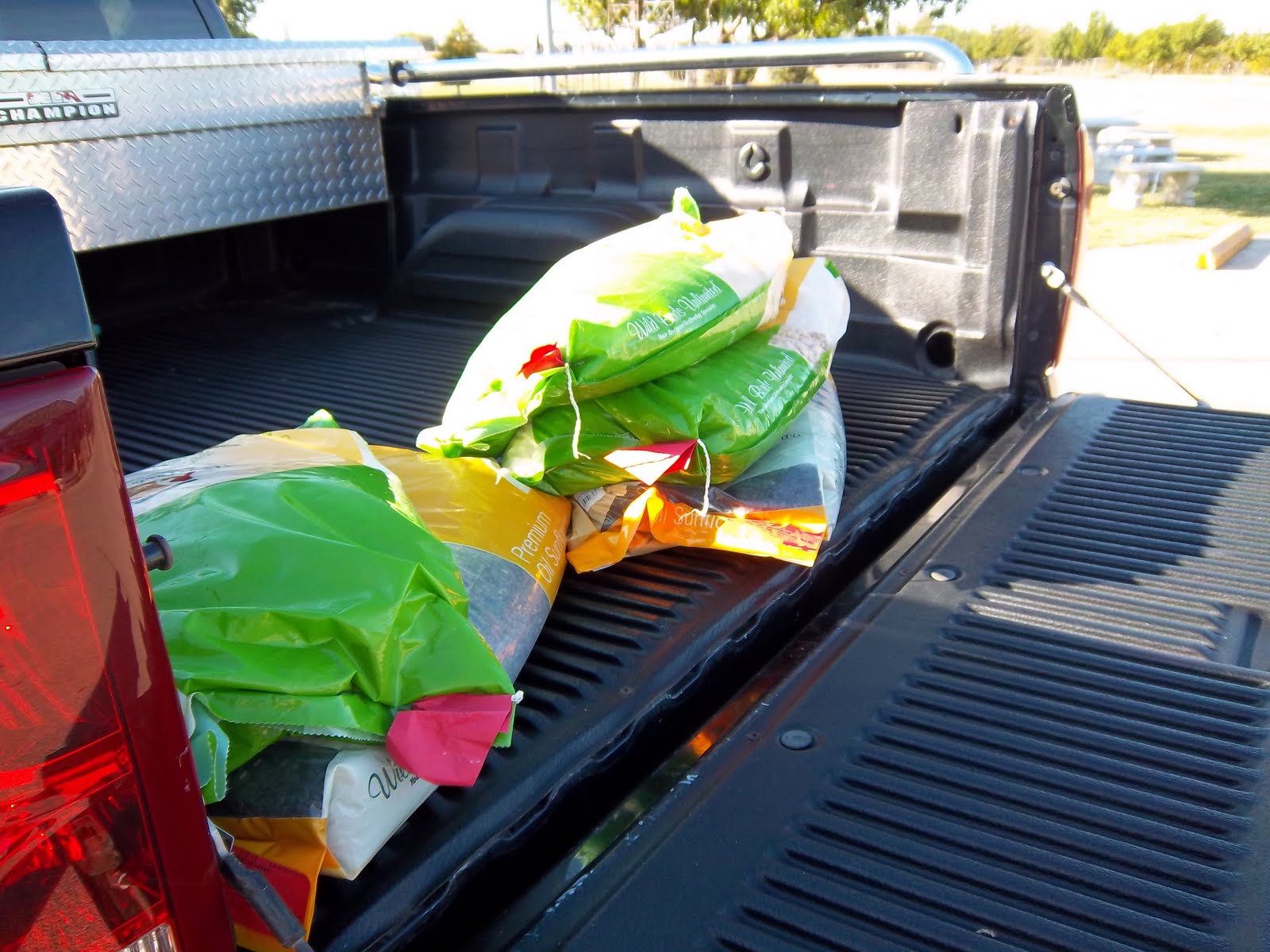
Anyway, I went to Wild Birds Unlimited as they have a 15% off sale on bird food until October 31 and got black oil sunflower, millet and peanuts without the shell. I decided to try out the Savers Card for $25, figuring I would save that much over the course of the feeder season. That got me an additional 5% off on the food on sale. That was nearly an additional $6. Since I am predisposed toward not liking to pay for a savers card, I am going to keep a spreadsheet to see if the card is worth the money and will let you know when I at least break even. You can see my haul to the left--the expensive bit was the bag of peanuts. But that one bag will likely be the only one I will need to buy this year.

I also started my Christmas shopping. Wild Birds Unlimited has some really cute bird Christmas ornaments that are very inexpensive as well as other gift ideas for the birders on your shopping list. If you know a birder and are stumped for gift ideas, email me at txbirds@gmail.com or wait for an upcoming post with gift ideas and links.

Anyway, time to unload, fill up the two feeders I am running right now, and then back to the workday (sigh.)

Good birding!

Friday, November 13, 2009

Filling the Larder

I went out shopping for bird food today, stocking the larder in preparation for Project Feederwatch that starts tomorrow.

As always, the only place I could find shelled peanuts was Atwood's. $8.39 for a 5-lb bag. They had both the whole nuts and the broken pieces for the same price. Since this is about the most expensive thing I buy, I prefer the birds have to do a little work for it, so I get the whole nuts.

Wal-Mart and Atwoods had the best prices on suet cakes. The year around suet at Wal-Mart was $1.19 and the premium mixtures $1.48. Atwood's basic price was $1.29.

I went to Berend Brothers to get my black oil sunflower and mixed seed. Partly because 100 lb of bird seed is more than I can handle and they are always very nice about loading it in the truck for me (hubby gets the joy of unloading)but mostly because I have always found the best quality mixed seed at Berend Brothers and THOUGHT I was getting the right kind today. Either Purina changed their mixture, Berend's is stocking a different mixure, or I picked up the wrong bag (looks the same to me though) because when I got home and opened the bag, I was very disappointed at the quality of the mix. I noticed that the amount of bird feeding food and accessories has dwindled at Berend Brothers, although I did find an item for the North Texas Bird and Wildlife Club gift exchange (sorry, can't tell what it is--I want it to be a surprise for the receipient.)

There was a premium mix I almost bought at Atwood's but it had quite a bit of safflower in it and very little millet. Although safflower is supposed to be preferred by cardinals, mine turn their beaks up at it.

I'll be cleaning out and hanging some of my additional feeders this afternoon.

Good birding!