Showing posts with label yellow-billed cuckoo. Show all posts

Sunday, July 12, 2026

Monthly Bird Outing

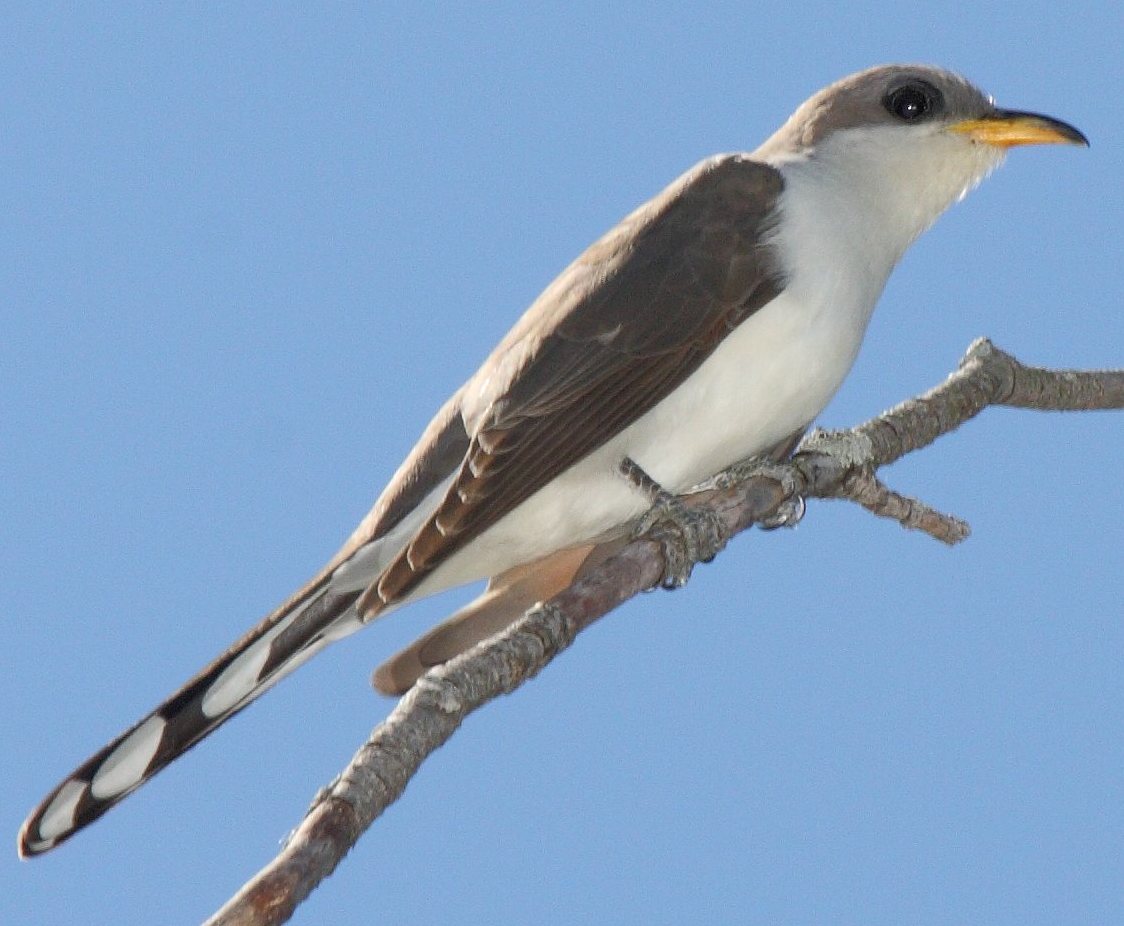
Yellow-billed Cuckoo
Dominic Sherony, CC BY-SA 2.0
 <https://creativecommons.org/licenses/by-sa/2.0>,
via Wikimedia Commons

July in our area generally sucks for bird watching. Part of that is a "me problem." I absolutely hate the heat and once temperatures get above mid-80's, I'm done. The projected high for Saturday was around 100.

But it's also the birds. The nesting season is largely over, and although birds do still sing, it isn't with the exuberance of spring. This makes birds harder to find. They, too, are hot and sticking to cover and out of the sun. Many birds are also worn out and some are starting to molt. It is a better survival strategy to lay low and not draw attention to oneself. 

Therefore, as a rule, our monthly bird outings at Lake Arrowhead State Park tend to be more poorly attended, and we see fewer species of birds.

However, we had a fairly decent morning yesterday. A breeze off the lake helped keep the temperatures bearable, although by the time we wrapped up around 9:30, things were becoming uncomfortable. My favorite bird of the morning was the yellow-billed cuckoo, although painted buntings are always nice. Yellow-billed cuckoos are considered threatened but are fairly common in the park during the summer. Because they are relatively secretive birds, we hear many more than we see.

Birds observed this morning were: Canada goose, killdeer, great egret, snowy egret, cattle egret, Forster's tern, cliff swallow, purple martin, mourning dove, Eurasian collared dove, turkey vulture, ladder-backed woodpecker, northern mockingbird, American robin, painted bunting, northern cardinal, orchard oriole, yellow-billed cuckoo, great-tailed grackle, brown-headed cowbird, and red-winged blackbird. Not a bad morning.

Just a reminder that these bird outings are every month on the second Saturday at 8:00 AM. We meet in the parking lot of the admin building (for those familiar with the park, it is between the swim beach and the fishing pier). You do need to pay park admission of $4 if you don't have a park pass. Since the office doesn't open until 8, plan a few extra minutes to visit the self-pay station. We saunter about a mile. The surface is level and easily maneuvered by those with mobility issues. You don't have to be a bird expert. This is a good opportunity to learn more about birds in a helpful, friendly group. Hope to see you at an upcoming outing.

Good birding!

Wednesday, July 16, 2025

Lake Arrowhead SP Monthly Bird Outing

Yellow-billed cuckoo
Dominic Sherony, CC BY-SA 2.0, via Wikimedia Commons

Saturday, 12 July, was our regularly scheduled bird outing at Lake Arrowhead SP. It's July, and typically, not the best month to be out birdwatching. That held true this month. Not the best month we've had, but not the worst either. Hot and humid though.

Birds seen included Canada goose, killdeer, great egret, great blue heron, snowy egret, double-crested cormorant, Eurasian collared dove, mourning dove, ladder-backed woodpecker, cardinal, eastern phoebe, cliff swallow, painted bunting, yellow-billed cuckoo, common grackle, great-tailed grackle, red-winged blackbird, and house sparrow.

Remember these outings are the 2nd Saturday of each month at 8 AM, regardless of the weather (unless the roads are icy). There is a $4 entry fee per adult to the park. We meet at the admin building parking lot, which is just on the other side of the building from the fishing pier. The walk is fairly level. We don't walk fast--we're looking at the birds (and other interesting plants and animals. The walk is about 1 mile--sometimes a little more if every one is up to it. Depending upon what we're seeing, the circuit can last from 1 hour - 2 hours. Beginners are welcome!

Good birding!

Tuesday, July 16, 2024

I Am Over Summer

Dominic Sherony, CC BY-SA 2.0, via Wikimedia Commons


 I am not a Summer fan. The prediction for today is 106 degrees. Ugh! Come on, Fall!

However, I did get out this morning early and did a short bird walk in Lake Wichita Park. I spent almost an hour, going down the chat trail, around the barrow pit, and most of the way around to Murphy's Mound. It was 80 degrees with a light breeze at 7AM when I started out and too darned hot by the time I got back to my car.

July is not the best time for birdwatching in Wichita Falls. The birds are finishing up raising their broods and most have ceased their territorial singing, making them harder to find in the foliage. Since we had more rain than usual so far this summer (yeah!), the foliage is fairly full. The birds are also too darned hot and not expending more energy than necessary and hiding out in the shade. Fall migration has now started. Our first spring migrant, the purple martin, has departed the area within the last week.

Having explained all the reasons birding sucks in late summer, I had a good morning. My favorite bird was the yellow-billed cuckoo (shown above). These birds are considered a threatened species and are secretive. I didn't see it this morning, but I heard its distinctive call. My birds this morning: double-crested cormorant, cattle egret, great egret, yellow-crowned night heron, green heron, mallard duck, Mississippi kite, Eurasian collared dove, mourning dove, yellow-billed cuckoo, northern cardinal, Carolina wren, blue jay, western kingbird, robin, scissor-tailed flycatcher, barn swallow, chimney swift, red-winged blackbird, common grackle, and great-tailed grackle.

Good birding!

Saturday, May 12, 2012

Bird Walk at Lake Arrowhead State Park, and After

Indigo bunting. Photo courtesy of Kevin Bolton, Wikimedia Commons.
Four people met me this morning for the monthly bird walk at Lake Arrowhead State Park. It was cool and overcast. Overall, the walk wasn't the best birding I have had at LASP, but neither was it the worst. We started over behind one of the camping areas, made our way near the swim beach and then drove over to the area around the group pavillion/nature trail area. I was hoping for a good migration bird day, but it didn't pan out. We did see some migrants; just not as many as I had hoped.

I think the only bird I saw before the others arrived that we did not see subsequently were some double-crested cormorants. Other than that, here are the birds we heard/saw: Canada goose, mallard, great blue heron, little blue heron, great egret, snowy egret, cattle egret, green heron, killdeer, spotted sandpiper, mourning dove, northern bobwhite, Bewick's wren, barn swallow, cliff swallow, purple martin, yellow-billed cuckoo,  northern mockingbird, scissor-tailed flycatcher, yellow warbler, Bullock's oriole, red-winged blackbird, great-tailed grackle, house finch, lark sparrow, dickcissel, and great crested flycatcher.

We also sighted one other bird that to me looked like a male orchard's oriole. I think the rest of the group was convinced it was just another sighting of the Bullock's as we saw it very briefly just before the Bullock's showed. However, I am going to stay true to my ID--there is too much difference between the two. I will admit the look was very brief, however.

The yellow warblers and Bullock's orioles were thick. We saw several of them. Sue and Warren wanted very much to see the yellow-billed cuckoo we heard, but we weren't successful at finding him. (Sorry guys. I did see one fly across the road in front of me on W. Arrowhead later.) We ended our outing about the time a rain shower started around 8:45. Although we only heard bobwhite in the park, I did see one on W. Arrowhead and then again later on FM 368.

After the rest of the group left, I did some of my mussel watch at an inlet between showers. There I added turkey vultures and American coot to my LASP list for the day.

Leaving the park, I decided I wasn't ready to go home, clean house and grade papers/final exams for my classes, so I decided to try out the Bridwell tank on W. Arrowhead Rd. I walked around along the road in that area and didn't see anything special. I got back in my truck and took off and what do I see on the fence? An indigo bunting! It didn't stay up long, which is normal, but it did provide a good look.

I drove down to the boat ramp and then circled back. Once again on FM 1954, I made my way to FM 368 and then over to Hwy 277 and home. Along the way, I did pick up a few more good birds, mostly in Archer Co, to include: upland sandpiper, yellow-crowned night heron, black vulture, kestrel, American crow, loggerhead shrike, Western kingbird, eastern phoebe, eastern bluebird, American robin, brown-headed cowbird, common grackle and house sparrow.

Along FM 1954 I encountered a large flock of blackbirds. I thought at first it was a flock of yellow-headed blackbirds. However, I didn't see a male among them. I did pull off and take a good look. There were five or six female yellow-headed blackbirds mixed into a flock of brown-headed cowbirds. I am lucky there were no males. I might have driven right by instead of stopping. If I had driven past, I wouldn't have picked up the two upland sandpipers.

On FM 368 I encountered a huge flock of migrating Bonaparte's gulls. The must have been nearly 100 birds in the flock. When I returned to Wichita Falls, there was another flock of well over 100 at the intersection of FM 369 (Southwest Parkway) and Barnett Rd. Fortunately, the light was red, so I could stop and put some binoculars on the flock circling overhead.

Overall, a good morning.

Good birding!


Thursday, May 10, 2012

Shorebird Weekend

I birded some on Saturday and on Monday at Lake Wichita. On Saturday I was conducting a Nature Trackers Mussel Watch and doing some invasives monitoring--I probably spent as much time birding as doing those projects. I started at the boat ramp off Kemp Blvd and walked down to the spillway, where there were several migrating shorebirds.

My species list for Saturday morning at Lake Wichita: Canada goose, American coot, mallard, great egret, cattle egret, Forster's tern, spotted sandpiper, white-rumped sandpiper, Baird's sandpiper, killdeer, Wilson's phalarope, black-necked stilt, double-crested cormorant, turkey vulture, rock pigeon, mourning dove, northern mockingbird, cardinal, yellow warbler, barn swallow, cliff swallow, red-winged blackbird, great-tailed grackle, common grackle, European starling, and house sparrow.

I then drove over to Crestview Cemetery, which has two small ponds. There I added lark sparrow, bobwhite, upland sandpiper, and scissor-tailed flycatcher.

On Monday I birded for about an hour, starting behind Wild Bird Rescue and then walking down the chat trail to the barrow pit. Behind Wild Bird Rescue I saw my first orchard oriole of the year, scissor-tailed flycatcher, white-rumped sandpiper, great-tailed grackle, white-winged dove, purple martin, great blue heron, red-winged blackbird and European starling. In Lake Wichita Park along the chat trail and barrow pit, I added mallard, canvasback, American coot, ruddy duck, black-necked stilt, great egret, Mississippi kite, Eurasian collared dove, American robin, northern mockingbird, yellow warbler, eastern phoebe, Carolina chickadee, northern cardinal, barn swallow, my first of season yellow-billed cuckoo, and chipping sparrow.

I was also lucky on the chat trail seeing a large red-eared slider and a rough green snake.

This morning while visiting the bank, I saw a green heron behind American National Bank on Midwestern/Maplewood.

Overall, a very good weekend. The only thing that could have made it even better would have been a lifer.

I got some email that there has been a brown pelican over between Seymour and Munday and a curve-billed thrasher on the north side of Lake Arrowhead State Park. It is a little far to drive for the brown pelican, unless I make a birding day of it. Haven't had any luck with the curve-billed thrasher.

Good birding!

Monday, May 24, 2010

Summer Birding

Sunday morning was very warm and muggy. When I went to Lake Wichita Park, the mosquitos were waiting. Fortunately, the breeze came up about 7:30, which helped keep the little bloodsuckers at bay for a little while. Then the wind died out and they were back with a vengence. Since I try not to wear bug spray too much (somehow spraying poison all over your body seems like a bad plan to me), I got a few bites. But most of my skin was covered. I do need to get a new supply of the non-DEET spray soon though.

The vegetation has really filled out, giving the birds lots of places to hide. If it weren't for the males singing to establish territories and attract mates, it would be very difficult to find the birds. Fortunately, they do.

In the summer, it is much more important to know the bird calls. The birds are easier to see in the winter and birds don't vocalize as much, so I tend to forget many of the calls and have to brush up every spring. But once you know the calls of at least some of the birds, a walk, even through areas of dense vegetation, can be a great birding morning. It is also fun to pick out the calls of baby birds--their calls are often quite different than the adults and very distinctive. Volunteering at Wild Bird Rescue in the summer provides a great opportunity to learn those calls.

Another good way to get better visibility on birds is by pishing. That is where birders stand and make silly noises to draw out the birds. I know there is at least one renowned birder who says this only works because birders actually stand still long enough for the birds to make an appearance, which they would have done without the pishing. I think that is Pete Dunne, but I wouldn't swear to it. While I agree pishing doesn't work for a lot of birds, I have found there are a few birds species that seem to find pishing irresistable--cardinals, spotted towhees, many sparrows, wrens, and a few others seem to pop out to see the goofy birders almost immediately. Sunday I managed to pull out a white-eyed vireo along the chat trail in Lake Wichita Park.

I heard a lot of yellow-billed cuckoos in the park yesterday. I saw one in flight--the rest were calling from the vegetation.

So to get the most out of your summer birding experience, learn the songs of the most common birds. You'll gradually expand your knowledge and enjoy birding even more.

Good birding!

Sunday, May 2, 2010

A Brillant Morning at Lake Wichita

It was a gorgeous morning on Lake Wichita and a great day for birding. I decided to start at the spillway, cross the dam and then bird the chat trail and the barrow pit.

When I got out of the car at the spillway, I knew it was going to be a great morning, even if I didn't see another bird. I heard dozens of clay-colored sparrows as soon as I got out of the car and as soon as I looked into Holliday creek, there were 12 snowy egrets. Things continued to get better with a flock of yellow-headed blackbirds at the top of the dam.

Even a poor day birding is a good day, but some days you remember for a long time. Today was one of those days. The thistle plants were all going to seed along the dam and there were hundreds (and probably thousands) of chipping and clay-colored sparrows rising up all around me as I walked. In fact, sparrows were good all the way around: in addition to chipping and clay-colored sparrow, I saw house sparrow, song sparrow, lark sparrow, savannah sparrow, and white-crowned sparrow.

A couple of first of season birds: yellow-billed cuckoo and male orchard oriole.

Here's my bird list for the two hours this morning (51 species): common grackle, great-tailed grackle, European starling, mourning dove, house sparrow, cliff swallow, killdeer, great egret, red-winged blackbird, snowy egret, great blue heron, Canada goose, eastern meadowlark, scissor-tailed flycatcher, yellow-headed blackbird, white pelican, chipping sparrow, song sparrow, Western kingbird, Savannah sparrow, American coot, yellow warbler, yellow-rumped warbler, barn swallow, chimney swift, double-crested cormorant, cedar waxwing, mallard, cardinal, turkey vulture, robin, house finch, blue-winged teal, ruddy duck, brown-headed cowbird, white-crowned sparrow, mockingbird, eared grebe, spotted sandpiper, red-tailed hawk, white-winged dove, blue jay, rock pigeon, American pipit, white-faced ibis, Eurasian collared dove, Carolina wren, orchard oriole, American goldfinch, yellow-billed cuckoo, and lark sparrow.

Good birding!