Showing posts with label Cornell Lab of Ornithology. Show all posts

Saturday, October 3, 2026

It's About That Time! Project Feederwatch

Errol Taskin/Project Feederwatch

 One of the activities I enjoy every year is Project Feederwatch. I see on the website that I have been participating for 28 years. Whew!

This citizen science projects provides important information on changes in bird populations over time. The Feederwatch website provides a summary of various studies and articles which used the information Feederwatchers have provided. However, the best part of Project Feederwatch is that you have another excuse to spend time watching birds.

The next Feederwatch season starts on November 1 and runs through April. There is an $18 fee to participate (Cornell Lab of Ornithology members are $15). However, you get a lot of enjoyment from that $18. 

This is an excellent activity for shut-ins and children. You can watch the birds from your windows. There is a minimum 15-minute timeframe to participate, which is great for kids, but you can observe for as long as you like. This is also a good activity for schools and scouts. If you have a group of children and would like to take part, but the fee is a barrier, email me at txbirds@gmail.com, and I'll see what I can do to support you on this.

Good Birding!

Thursday, February 12, 2026

Time for the Great Backyard Bird Count (GBBC)!


One of my favorite birding activities is the Great Backyard Bird Count every February. Birders have several bird count activities, all of which provide data used to monitor population trends.

Basically, participants count birds in any location they wish (yard, local park, etc.) for a minimum of 15 minutes during a 4-day period. This year that is Friday, Feb 13 - Monday, Feb 16. Then you provide the information via Merlin or eBird.  Merlin is probably the app of choice for a new birder; eBird has more functions, but a little more complicated to learn for a newbie. You count every bird you see and you can count as long as you want, just at least 15 minutes.

Our monthly bird outing at Lake Arrowhead State Park on Saturday, Feb 14 will be part of the GBBC. If the weather forecast is accurate, we might get a little wet. We meet in the parking lot near the fishing pier at 8:00 AM. You might arrive a little early in order to stop at the self-pay station, since the office doesn't open until 8:00. We saunter for about 1 - 1.5 hours (depending on the weather and the birds) and cover around a mile. We don't move very fast. We're there to watch birds, not set speed records. The route is paved and level. We do have people come with limited mobility, so don't let physical restrictions put you off.

I will also be birdwatching on the other days as well. Friday at Lucy Park, Sunday at Wichita Bluff, and Monday at Lake Wichita Park.  I may try to slip in a couple of other short observation periods at a few other locations, time permitting. It's a busy weekend already, so it will be a spur of the moment thing.

This is a fun activity to get kids involved. Since you only have to take part for 15 minutes, it isn't a challenge to keep them involved. If you have a budding birder, then you can stretch the activity as long as you want. Instructions for participating are available on the GBBC website.

If you have any questions or would like to participate in one or more of the counts, contact me at txbirds@gmail.com.

Good birding!

Friday, December 26, 2025

A Silent Christmas Bird Count


A book that started my journey to environmental awareness as a child was Silent Spring by Rachel Carson. This book was instrumental in eliminating (mostly) the use of DDT in the U.S., allowing for the comeback of the bald eagle. However, other factors beside DDT are having a devastating impact on our birds today

Last Saturday (December 20) was our local Christmas Bird Count (CBC). This was the 50th year our count was conducted (except for 1983, which for some reason, there is no record of a count being done).

Although it was a beautiful day, the count was disappointing. We ended the day with around the normal number of species seen, but significantly lower numbers of each species. The CBC requires the participants to count every single bird seen. We had 81 species, but only 18,409 individual birds, with 8 participants counting. This is very low number. We have noticed this trend in previous years. Sometimes, you can chalk up low numbers to poor weather--not this year.

This isn't surprising. We have been losing birds for many years. In 2019 the Cornell Lab of Ornithology published an article in its publication, Living Bird, which highlighted a study, documenting that North America has lost almost 30% of its birds since 1970. The largest losses were in grassland birds, which are primarily what we see here.

Why? In the case of grassland birds, it is largely due to a loss of habitat, as the original grassland prairies have largely been exterminated. The prairie is the most endangered ecosystem on earth with less than 1% of the original grassland prairie in Texas still in existence. Yes, there are rangelands covering a large part of Texas, but that is not the same habitat.

In several parts of our CBC area, there is a lot of development happening. A subdivision in Archer County that is part of my area, has quail names for its streets. There were probably quail there when the houses were built, but I doubt many of the inhabitants see or hear many quail now. All of the houses have suburban-type yards, which are not the habitat quail need to reproduce and survive. Across the street from this housing addition, there is adequate habitat (but not the best), so some may still be in the area, but if that housing area expands, it will further reduce quail territory.

Another issue is insects and other invertebrates. Not that many years ago, a drive meant you had to clean your windshield regularly to get the bug guts off. That is a rarity now. Insect populations are plummeting. Although many adult birds eat seeds, baby birds eat insects. A lot of insects. Insects are high in nutrients, as baby birds grow fast. Fewer insects mean less food and less food means fewer baby birds, and fewer adults. Much of the decline in insect populations is due to the use of pesticides. However, even areas with little disturbance, insect populations are plummeting. One study showed insects declines 72.4% in 20 years in a relatively untouched area in CO. This decline appeared to be due to rising summer temperatures.

Many of these seem issues might seem to be beyond the scope of any one person's ability to impact. Although it is true that many issues require the collective efforts of large communities, there are still things we can do to help our birds.

  • Build habitat. Ditch the lawn or most of it. Plant native plants--they feed more of your local area insects and birds. For ideas, see Homegrown National Park.
  • Use poisons on your yard sparingly, if at all. They aren't good for you, your family, pets, or the habitat.
  • Keep your cats inside. I love cats, but they love to hunt, hungry or not. Cats kill between 1.3 and 4 billion birds annually in the U.S.
  • Reduce the use of plastics. Plastics kill wildlife. As they break up into smaller pieces, they are often eaten by birds (whether directly or indirectly in the intestines of their food), filling their stomachs with undigestible food, until they starve to death. I do know it is very hard to avoid plastic, so what you do have, dispose of it carefully.
  • Introduce people to birds. People don't develop strong attachments to things they are not exposed to. The more people observe and learn about these fascinating birds, the more likely they are to advocate on their behalf.
Good birding!

Wednesday, August 6, 2025

Listing

Field list

Bird people are notorious for their lists. Many keep all kinds of lists. The most significant list is their life list. As you might guess, a life list is a list of every bird you have seen in your lifetime, usually with the date and place you identified the bird first.

Before the advent of computers, everyone kept their life list on paper. Not ideal. I have lost my life list twice. Once you lose the documentation, you can't remember every bird you have seen, let alone when and where. Now, we have eBird, which protects your list. But I know I have seen a LOT of birds that are not on my current list, especially from the years I spent in Europe. I still have hope that I come across the list in one of the boxes in the garage that haven't been unpacked since our last move.

eBird does have a phone app. I have it on my phone, but I don't use it. It would make sense to do so, since I have to take my field notes and enter them into eBird when I get home, which means I have a lot of checklists that I haven't entered. And, as you can see in the photo, my field list is a little messy. I am working on entering some today.

If you would like to use eBird, you might consider taking the Cornell University Lab of Ornithology Bird Academy course eBird Essentials. It's free. There's a lot of things you can do with eBird besides keeping your lists.

In addition to life lists, birders keep yard lists, state lists, county lists, patch lists, etc. There is a Texas Century Club to encourage birders to find 100 birds in 100 counties in Texas (for those not familiar with Texas, we have 254 counties). There are several counties in Texas that are sparsely populated and bird records were few. The Century Club, and eBird, have greatly improved our knowledge of bird ranges. 

I can recall many years ago, when I would update a sighting in Wichita County, I would get calls from the people who try to help keep eBird accurate, questioning my entry since the bird wasn't supposed to be here or not at that time or in those numbers. Since I don't carry a camera, I don't take a lot of photos to prove I saw what I saw. Fortunately, there are a lot of people who do carry cameras and provide photographic evidence, and now there is plenty of documentation that the birds are in our area, which has made challenges rare.

I do know (a very few) birders who do not list. They feel keeping lists detracts from the experience of observing the birds. And I get that. Some people do seem to just want to tick off a bird on their list and not spend any time enjoying the bird. But I don't think that's true of most.

Truly, the best thing about lists is the memories they bring back. When I look at sightings, I can often remember the place, the people I was with, or some other fact about the day. I was on a hike in Copper Breaks State Park this weekend, and one of the people I was with stopped in the middle of a trail and said, "It was at this exact spot that I heard a canyon wren..." I often stop at places I have seen a special bird just to remember how I felt at the time.

To list or not to list...it's a question only you can answer for yourself.

Good birding!


Sunday, September 22, 2024

Project Feederwatch Starting Soon


Feederwatch Crowd

One of my favorite thing to do in the winter is participating in Project Feederwatch. This is a study of bird populations sponsored by the Cornell Lab of Ornithology and Birds Canada. According to the Project Feederwatch website, this will be my 27th season.

My primary reason for taking part is that I like to watch the birds. I feed them regardless, so why not provide information that can help up learn more about them? The picture at the left is one from my backyard a couple of years ago during a particularly harsh bit of weather. The interesting thing, although you can't see it without enlarging the picture, is that there are some yellow-headed blackbirds in this photo. I had never seen yellow-headed blackbirds in the winter here--I thought they were a migrant that passed through in spring and fall. Apparently, a few do hang around (or at least, did that winter).

Last winter was particularly disappointing. I didn't have many birds at all-neither in numbers of species or in numbers of individuals. Some of the other local people who participate mentioned they were having a disappointing season as well. I chalked it up to a relatively mild winter. However, recently I received the newsletter for the project summarizing some of the data from last year, and we were not alone. Last year was a bad year for every one--in fact the numbers of individual birds seen was down significantly everywhere.

Chart from Sep 12 Feederwatch blog

You might find the possible reasons for these low numbers interesting. Check out the blog post. However, bird populations are declining everywhere. The link takes you to the Cornell Lab's page highlighting a study showing that nearly 3B birds have disappeared since 1970. This is not good news for us. Another reason to do what you can to provide habitat for all species, not just birds.

The Project Feederwatch starts November 1 and runs through April 30. If you want to take part, there is a small charge. If you are a member of the Lab, the cost is $18. It is a few dollars more for those who are not. If you are new to the project or don't know your birds very well, Cornell will send you a poster of common birds.  It's also a good idea to have access to a field guide. Here's the link to sign up.

I hope you'll take part. This is a good project to do with kids as well. They learn more about birds and about the scientific method.

Good Birding!


Sunday, February 4, 2024

Great Backyard Bird Count Coming Up!

One of my favorite birding events is coming up February 16 - 19. The Great Backyard Bird Count is a joint citizen science project of the Cornell Lab of Ornithology,  National Audubon Society, and Birds Canada. It has found its way worldwide since tallies are now submitted through eBird.

The idea is to watch birds at home, your local parks, or wherever you happen to be for 15 minutes (or more) and submit your checklists through eBird. I usually try to hit up several local parks since I do Project Feederwatch in my yard every week. I might change my mind, but right now, I am thinking I will bird Lake Wichita Park on Friday, Lake Arrowhead SP on Saturday, Wichita Bluff Park on Sunday, and Lucy Park on Monday. I might throw in some short times at Williams Park and the Circle Trail at a couple of spots that are sometimes good birding.

This is a great project for kids. Since you only need to spend 15 minutes, even the little ones can stay focused. This would also be a good project for homeschoolers.

Good birding!

Saturday, December 30, 2023

It's Project Feederwatch Time!

The Cornell Lab of Ornithology has several citizen science projects. Project Feederwatch is one of them. I have been participating for 26 years. It doesn't cost much to take part, it doesn't require a lot of time, and anyone can take part, regardless of mobility. It's a fun activity to do with kids as well.

Loki's "Time to feed the birds" stare
My dogs, Loki and Sirius, love to feed the birds. I'd say it's their favorite activity outside of breakfast and dinner. I usually go out to feed the birds after breakfast. If I don't, the boys will stare at me. If that doesn't work they will start nudging me or climbing up in my lap to remind me the birds are starving.

They could care less about the birds eating. They love eating the bird seed themselves. Since I ground feed as well as put food in the feeders, they graze on the food on the ground. I try to scatter it all over the yard so they don't eat it all. I don't buy cheap bird food.

The boys grazing on bird food
Last year, I carried a 20-lb bag of black oil sunflower seed out back to put in the bin and discovered I didn't have my scissors to open it, so I set the bag on the deck to go back in the house to get them. Once I got in the kitchen to get my scissors, I got distracted (the story of my life), so it was a good half hour before I remembered I still needed to put the food in the bin. When I went out, one of the dogs (probably Loki) had ripped open the bag and eaten a couple of cups of sunflower seed. Fortunately, sunflower seeds are not bad for dogs (although Loki is part goat and eats anything he can get into his mouth).

Project Feederwatch runs November through April. Although it is underway for this year, it isn't too late to sign up. You still have some months to enjoy the birds in your yard and contribute to our knowledge of birds.

Good birding!

Saturday, January 30, 2021

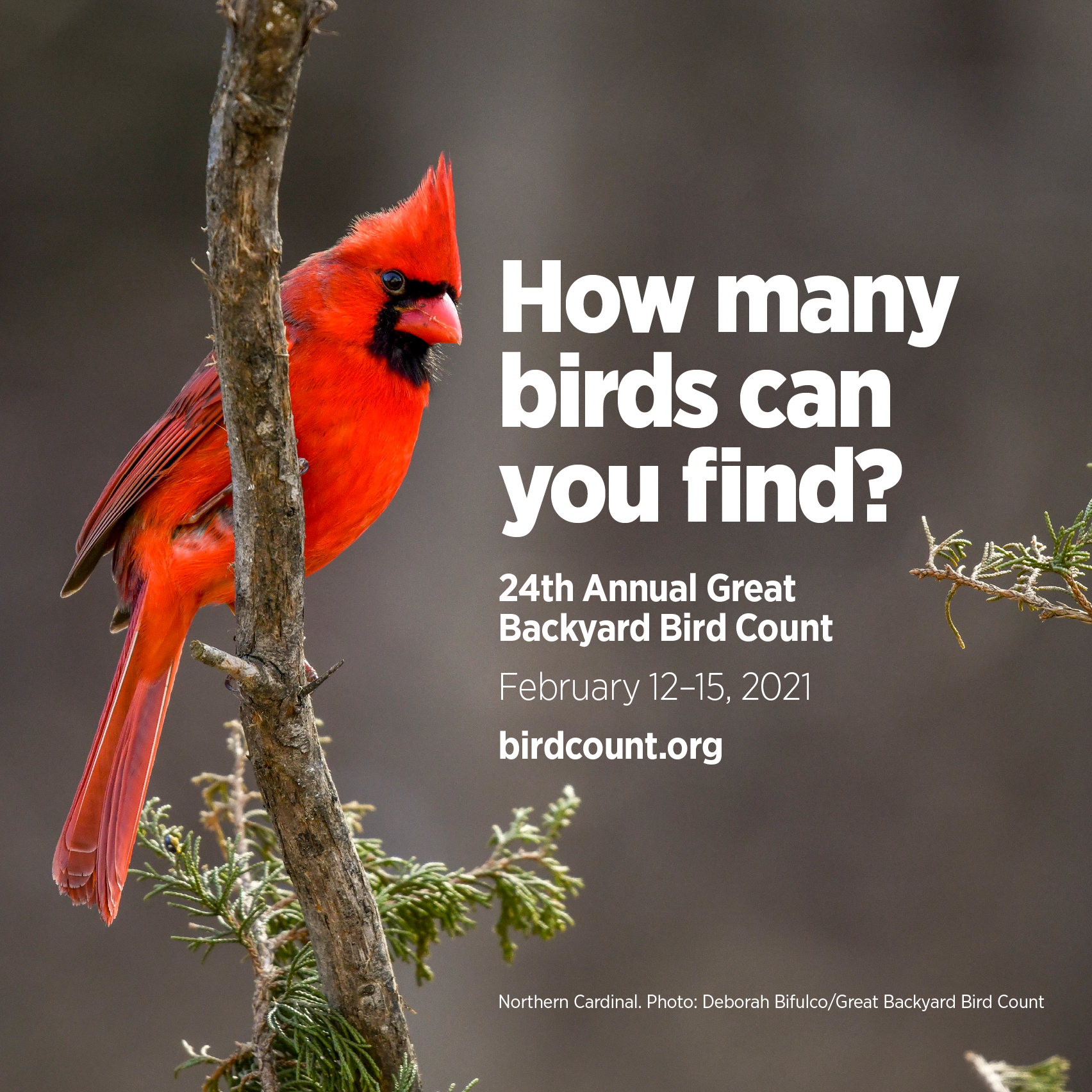
Great Backyard Bird Count

 The Great Backyard Bird Count (GBBC) is 12 - 15 February 2021. The count is an annual event, sponsored by The Cornell Lab of Ornithology, the Audubon Society, and Birds Canada. I have taken part for several years. The GBBC was launched in 1998 as a citizen science project to capture a snapshot of bird populations.

I block the mornings of these days out well in advance. I usually spend about two hours each of the mornings birding in the local parks and then some time later updating eBird with my findings. However, you can use any period of 15 minutes or more and your yard is fine, so anyone can participate. Last year, over a quarter million people around the world took part, documenting just over 6,900 species of birds.

This is a great activity to do with the kids. Since you're not required to devote a lot of time, if the kids (or your non-birding significant other) get bored, you have still contributed to our knowledge of birds.

The next Lake Arrowhead State Park bird walk occurs during the GBBC, so if you want to go with a group, plan to attend the bird walk on that date. February 13, 8:00 AM. COVID-19 safety requirements will still be in place. Currently, the requirements include no group larger than 10, social distancing, masks, and no sharing of binoculars or field guides. Those requirements may change, so check with the park the day before.

I usually publish the dates I plan to go to the various parks in case someone wants to go with me, but due to COVID-19, I am not doing that this year. However, if you would like to go, you can email me at txbirds@gmail.com--all of the COVID-19 safety requirements will be in effect, however. I plan to bird 8:00 - 10:00 each day, longer on the days I do the Wichita Bluff Nature Park segment and a portion of the Wichita Valley Rail Trail, due to the length of the trail. If I'm having a good day, I sometimes add short stops (15 - 30 minutes) at some local hot spots.

Plan to take part. If you are not already signed up with eBird, you will need to set up an account and become familiar with at least the basics to update your count information.

Good birding!


Tuesday, November 8, 2016

Project Feederwatch Starts This Weekend

Downy woodpecker.
Photo by Errol Taskin/Project Feederwatch
One of my favorite citizen science activities is Project Feederwatch. I have been participating for 18 seasons! Feederwatch is a good way to learn the common birds that regularly visit your backyard. It would be a great project to do with your kids or grandkids. I count birds every time I pass by my windows and keep a running tally for the two days. It only takes about 5 minutes to input the count data each week.

Although I feed birds all year, I put out additional feeders in the Feederwatch season. I started adding feeders last weekend and will have them all up by this weekend.

Project Feederwatch only costs $18 per year to participate ($15 if you are a member of the Cornell Laboratory of Ornithology.) There is still time to sign up.

For more information about the program and what the data is used for, see the Project Feederwatch Project Overview.

You can watch the birds from the comfort of your warm, dry home; enjoy the birds; and contribute to our knowledge of these fascinating animals.

Good birding!

Friday, February 5, 2016

Great Backyard Bird Count

One of my favorite events of each winter is the Great Backyard Bird Count (GBBC), held mid February of each year. The GBBC is a joint effort of the Cornell Lab of Ornithology and the Audubon Society. It is a global event, with people in many countries sending information on the birds they see during their backyard count. Last year participants submitted over 147,000 checklists, counting over 5,000 species of birds.

I have blocked out the mornings of the next 4-day count, February 12 - 15, in order to participate.

You do not have to be a great birder to take part. In fact this is an excellent way to introduce new people to birdwatching, so it is perfectly fine if you are new to the hobby. Nor do you have to spend a lot of time (unless you want to.) How do you take part?

  • Choose a nearby location (your backyard is fine.)
  • Find at least 15 minutes to watch birds
  • Count every individual bird you can identify
  • Submit your counts (you may have to set up an account if you are not already registered with eBird or one of the Cornell Lab citizen science projects.)
This is a great project to do with your children or grandchildren, since it doesn't require a long attention span. It could also be a great introduction to birds for home schoolers, classrooms and scout troops.

One of the GBBC counts will be the monthly bird walk at Lake Arrowhead State Park on Saturday, February 13. It will start at the firewood shed (1st camping area to your left after you enter the park) at 8:00 AM. The entry fee to the park does apply.

Usually there is a group Rolling Plains Texas Master Naturalist count on Sunday. I haven't heard if that is happening and it isn't on the chapter calendar. I am keeping that date open, just in case.

I will be doing a count at Lucy Park on Friday, beginning at 8:00 AM. If anyone is interested in taking part, just meet at the first parking area on the left after entering the park on Sunset Street (the entrance adjacent to River Bend Nature Center and behind the Sanitation Department.) 

I will also be doing a count at Lake Wichita Park beginning at the head of the Chat Trail beginning at 8:00 AM on Monday, February 15.

Anyone who wants to take part is welcome to come along. If you need more information, send me an email at txbirds@gmail.com. Be sure to put GBBC in the Subject line so I don't think your email is spam.

Good birding!


Tuesday, January 5, 2016

Happy National Bird Day!

Blue Jay
Who knew?

I didn't realize there was a National Bird Day. In reading through the website, you can see that it seems devoted to better treatment of pet birds, although it is obvious their thoughts are that birds are not pets and should live life "outside the cage." Their focus is on the conservation of birds that are used in pet trade.

However, I am not one to quibble. I am just happy that there is any effort to show people how intriguing and how important birds are in our ecosystem. But, as far as I am concerned, every day is Bird Day!

Why not celebrate Bird Day with a donation to some bird-related cause? Some local 501(c) options:

  - Wild Bird Rescue rehabilitates wild birds and returns them to the wild for all of us to enjoy. They are hosting 11 barn owls right now in addition to some other birds--these are very expensive to feed and house to release.
  - River Bend Nature Center, which does not focus on birds, but does help our community better understand the ecosystem as a whole.
  - Texas Master Naturalist, Rolling Plains Chapter, which trains volunteers to help others learn more about the environment. The group does many projects gathering and reporting information useful to learning more about the birds in our area as well as providing programs and events to connect people with our local plants and animals.

Two other options for you out-of-towners:

  - Texas Ornithological Society
  - Cornell Lab of Ornithology

Even better, watch the birds in your backyard, on the Circle Trail or at one of our local parks.

Good birding!

Monday, March 31, 2014

Project Feederwatch Season Ends

This past weekend was my last Project Feederwatch observation period for this season. I have participated for 16 seasons.

Overall, it was a pretty disappointing season for me. We moved a couple of years ago and our yard is not nearly as bird-friendly as previous years. With the drought, I have not been able to make the wildscape improvements as quickly as I would like. Hoping the drought breaks soon. This year, out of 22 observation periods I had a grand total of 17 species--mostly less desirable species like white-winged doves, Eurasian collared doves, house sparrows and European starlings. I just keep trying to remember that the data is important, even if not what we want.

I have already signed up for next year and am hoping for a good year. Why not sign up? It's a good way to commit yourself to take the time to watch the birds in your backyard. This would be an excellent project for home schooling or as an activity to do with your kids. My 2-year-old granddaughter loved to feed the birds and to watch the doves all trying to fit on the platform feeder. I am hoping to have better luck turning her into a birder than I did with my kids. It's only $15 if you are not a Lab of Ornithology member; $12 if you are.

Good birding!


Monday, March 17, 2014

New Cornell University Programs

Barn Swallow by Walter Siegmund,
Wikimedia Commons
The Cornell Lab of Ornithology is looking for people with nesting barn swallows to help in conducting a study on the effect of light on these birds. Although barn swallows haven't yet returned to our area, if you usually have nesting barn swallows, you can learn more from a recent newsletter article

I'm a little late bringing this to you, but Cornell is getting ready to launch their duck ID webinar series again, as well as the shorebird identification webinars. I have taken the shorebird series and learned a lot. I am going to sign up for the duck series this time, even though I am pretty good on ducks, and they're all getting ready to leave the area again until next winter. However, I can use some help on the non-duck swimming birds (grebes, etc.) I can't wait for the crow series to come back around. They are fascinating birds.  At $10 a webinar, these are within reach of most budgets, if you take one at a time.

Good birding!

Friday, November 29, 2013

Trying to Shop for a Birdwatcher?

Every once in a while I try to help those who have birdwatchers on their Christmas lists by providing some ideas. I don't do this every year, but if you want to go back through some previous lists, here is the link to the 2009 blog post and the 2011 blog post. They are still perfectly valid and I promise your birding family members and friends will love the gift. Since both of these posts are extensive, I won't go back through all of the ideas, but instead focus on a few newer choices.

Although I have reviewed several books this year, here are my suggestions for some newly published bird books your birding friend may very well not have: The Warbler Guide and The Crossley Guide: Raptors. There are other fine books out there, but these two are a cut above.

If you have people on your list who are trying to improve their field birding skills, the Cornell Lab of Ornithology has some excellent webinars for a relatively low cost. They also have some other, more intensive courses that are more expensive. For a variety of learning opportunities, check out their website. I've taken some of these courses myself. A Cornell membership would be welcomed by most birders--the recipient would get a beautiful magazine as part of their membership and have the opportunity to participate in several citizen science activities if they are interested.

Wild Birds Unlimited in Wichita Falls also has some nice gifts: High quality T-shirts, books, binoculars, feeders and birdseed would be welcome gifts.

For the birder with everything, I would again recommend a donation to a birding organization. Wild Bird Rescue is always in need of monetary donations, especially to support their Avian Ambassador program. Who wouldn't want to sponsor a hawk or an owl?

Good luck with your Christmas shopping!

Good birding!

Sunday, July 28, 2013

New Webinar Series from Cornell Lab of Ornithology

The Cornell Lab of Ornithology is a great resource for people who love birds. I have taken some of their courses before. The Lab recently announced a series of three, 1-hour webinars on shorebird identification. Since shorebirds tend to kick my butt in the field, I decided to sign up. The webinars are $10 each.

I attended the first session on Friday, and it is a great course to learn about shorebirds. I went to Lake Wichita Park yesterday to put my new knowledge to the test. Wow! I quickly identified a plover and a dowitcher and then spent the time narrowing the field to a snowy plover and a long-billed dowitcher. Previously, I would have spent an hour trying to get an identification--it took just a few minutes yesterday. Not to say I am an expert by any stretch, but the hints given in the class sure cut down on my confusion. I can say this webinar was $10 well spent. I am looking forward to the remaining two webinars, focusing more on the individual species.

If you miss the window to sign up for this round, the courses will repeat at another time. I am waiting for the waterfowl series to come back around as I wasn't able to attend last time.

Good birding!

Sunday, January 6, 2013

So Far, A Boring Project Feederwatch Year

I have participated in Project Feederwatch (PFW) for many years, regularly recording the birds visiting my feeders and updating the sightings in the PFW database.

This year has been exceedingly boring. The primary I have seen are house sparrows, white-winged doves and Eurasian collared doves. We did get some colder weather and some snow over the past few weeks. Consequently, I did finally have a couple of Inca doves, dark-eyed juncos and house finches show on Feederwatch days. But overall, the year has been pretty discouraging. I just don't have the same habitat in my yard that encourages birds. But even very common birds tell Cornell something. So we'll keep observing, recording and reporting the data.

Good birding!

Friday, November 9, 2012

Birdy Weekend Coming Up

The bird walk at Lake Arrowhead State Park is Saturday, November 10, 8:00 AM. We meet in the first camp ground to the left at the firewood shed.

Also this is the first weekend for this season's Project Feederwatch. If you haven't registered but would like to take part, you can sign up at the Cornell web site.

Good birding!

Wednesday, September 5, 2012

Book Review: Bird Sense

I just got a new book (published in April) in the mail, and it is absolutely fascinating. Bird Sense: What It's Like to Be a Bird, by Tim Birkhead, explores how birds perceive their world through their senses, and how that perception affects their lives.

The book does provide a lot of anatomical and physiological information, but in a way that the average reader won't be intimidated. Historical accounts illustrate how we made the discoveries about how senses work. One very interesting discussion revolves around how well birds smell, using the turkey vulture to illustrate. That question is still debated in the general public.  I'm not going to give you the answer; read the book and discover it for yourself.

I am currently enrolled in the Cornell ecourse, Courtship and Rivalry in Birds, in which one of the discussions going on is emotions in birds--there is a chapter in this book on that very topic. Birkhead's conclusion is that birds do feel emotions, but not in the same way we do.

This is not a long book (around 200 pages of text), but is very well documented if you want to find out more.

This is another one of those books that should find a place on every birder's book shelf. $25 retail/$13.25 hardcover on Amazon/$9.99 for the Kindle edition.

Good birding!

Tuesday, May 29, 2012

Book Review: Sparrow by Kim Todd

I am not a big fan of the house sparrow overall. In a previous post I mentioned a new book about the house sparrow I intended to buy and review. I discovered this book when reading a newsletter from the Celebrate Urban Birds program from the Cornell Lab of Ornithology.

Well, I bought the book, Sparrow, by Kim Todd from Amazon and discovered a delightful read. As I said, I am not a big fan of the house sparrow, primarily due to its detrimental effect on some of our native birds, like the eastern bluebird. However, one has to admire a bird that has managed to spread over 6 continents and become so successful.

Ms. Todd brings out the impact of this tiny bird (and other sparrows) on literature and art as well as the story of its success.  I particularly enjoyed the discussion concerning the study of house sparrows in learning more about evolution and bird song. Ms. Todd ends her book with a discussion of the decline of house sparrow populations in many cities. Although the question about why this is happening is still unanswered, the possibilities point to the house sparrow as a possible "canary in the coal mine." In one study it seemed the house sparrows decline was due to underweight and undernourished babies due to a decline in insect populations in the city (a seriously bad thing) and in another, due in part perhaps to a large increase in raptor populations (which would be a good thing.) It will be interesting to discover the result of further research.

This was just a fascinating book--I can't recommend it too highly.

Good birding!                                                                                                              

Wednesday, April 4, 2012

Project Feederwatch Year End

One set of feeders out back.


This past weekend was my last count for Project Feederwatch. Since  my winter feeder birds are gone and the numbers of birds visiting the feeders is down, I guess it's time.

I am swapping out my feeders for the summer. I feed all year; I just don't feed as much and I switch up the food. Over the summer, I'll have the two tray feeders, the hummingbird feeders and the mealworm feeder. I should have the changes all made by this weekend.

If you can, consider joining Project Feederwatch next year. The season starts in November, but be sure to sign up early so you receive your materials in time.

Good birding!