Showing posts with label eBird. Show all posts

Thursday, February 12, 2026

Time for the Great Backyard Bird Count (GBBC)!


One of my favorite birding activities is the Great Backyard Bird Count every February. Birders have several bird count activities, all of which provide data used to monitor population trends.

Basically, participants count birds in any location they wish (yard, local park, etc.) for a minimum of 15 minutes during a 4-day period. This year that is Friday, Feb 13 - Monday, Feb 16. Then you provide the information via Merlin or eBird.  Merlin is probably the app of choice for a new birder; eBird has more functions, but a little more complicated to learn for a newbie. You count every bird you see and you can count as long as you want, just at least 15 minutes.

Our monthly bird outing at Lake Arrowhead State Park on Saturday, Feb 14 will be part of the GBBC. If the weather forecast is accurate, we might get a little wet. We meet in the parking lot near the fishing pier at 8:00 AM. You might arrive a little early in order to stop at the self-pay station, since the office doesn't open until 8:00. We saunter for about 1 - 1.5 hours (depending on the weather and the birds) and cover around a mile. We don't move very fast. We're there to watch birds, not set speed records. The route is paved and level. We do have people come with limited mobility, so don't let physical restrictions put you off.

I will also be birdwatching on the other days as well. Friday at Lucy Park, Sunday at Wichita Bluff, and Monday at Lake Wichita Park.  I may try to slip in a couple of other short observation periods at a few other locations, time permitting. It's a busy weekend already, so it will be a spur of the moment thing.

This is a fun activity to get kids involved. Since you only have to take part for 15 minutes, it isn't a challenge to keep them involved. If you have a budding birder, then you can stretch the activity as long as you want. Instructions for participating are available on the GBBC website.

If you have any questions or would like to participate in one or more of the counts, contact me at txbirds@gmail.com.

Good birding!

Wednesday, August 6, 2025

Listing

Field list

Bird people are notorious for their lists. Many keep all kinds of lists. The most significant list is their life list. As you might guess, a life list is a list of every bird you have seen in your lifetime, usually with the date and place you identified the bird first.

Before the advent of computers, everyone kept their life list on paper. Not ideal. I have lost my life list twice. Once you lose the documentation, you can't remember every bird you have seen, let alone when and where. Now, we have eBird, which protects your list. But I know I have seen a LOT of birds that are not on my current list, especially from the years I spent in Europe. I still have hope that I come across the list in one of the boxes in the garage that haven't been unpacked since our last move.

eBird does have a phone app. I have it on my phone, but I don't use it. It would make sense to do so, since I have to take my field notes and enter them into eBird when I get home, which means I have a lot of checklists that I haven't entered. And, as you can see in the photo, my field list is a little messy. I am working on entering some today.

If you would like to use eBird, you might consider taking the Cornell University Lab of Ornithology Bird Academy course eBird Essentials. It's free. There's a lot of things you can do with eBird besides keeping your lists.

In addition to life lists, birders keep yard lists, state lists, county lists, patch lists, etc. There is a Texas Century Club to encourage birders to find 100 birds in 100 counties in Texas (for those not familiar with Texas, we have 254 counties). There are several counties in Texas that are sparsely populated and bird records were few. The Century Club, and eBird, have greatly improved our knowledge of bird ranges. 

I can recall many years ago, when I would update a sighting in Wichita County, I would get calls from the people who try to help keep eBird accurate, questioning my entry since the bird wasn't supposed to be here or not at that time or in those numbers. Since I don't carry a camera, I don't take a lot of photos to prove I saw what I saw. Fortunately, there are a lot of people who do carry cameras and provide photographic evidence, and now there is plenty of documentation that the birds are in our area, which has made challenges rare.

I do know (a very few) birders who do not list. They feel keeping lists detracts from the experience of observing the birds. And I get that. Some people do seem to just want to tick off a bird on their list and not spend any time enjoying the bird. But I don't think that's true of most.

Truly, the best thing about lists is the memories they bring back. When I look at sightings, I can often remember the place, the people I was with, or some other fact about the day. I was on a hike in Copper Breaks State Park this weekend, and one of the people I was with stopped in the middle of a trail and said, "It was at this exact spot that I heard a canyon wren..." I often stop at places I have seen a special bird just to remember how I felt at the time.

To list or not to list...it's a question only you can answer for yourself.

Good birding!


Monday, July 29, 2024

What's the Deal With Lists?

List, Parque Edwardo VII

Many people who enjoy birds keep lists. Most keep a life list. Others keep all kinds of lists (patch list, county list, etc.) Why list?

First, some birders do not keep lists. They feel that focusing on listing interferes with enjoying the birds because you are recording your sighting instead of truly looking at and absorbing the experience. And that can happen, although I don't think listing and observation are mutually exclusive.

For those who list, there are various reasons.

  • Competition. Having large life lists can be a big deal and people can become competitive. And yes, there are birding competitions, both formal and informal. If you haven't seen it, watch The Big Year. It's a comedy, and most birding people do find it funny. My husband, who has little interest in birds, didn't find it funny at all. He just didn't get some of the jokes. People do engage in big years. I followed the blog of a person doing an ABA-area big year (The ABA area is the 49 continental United States, the Hawaiian Islands, Canada, the French islands of St. Pierre et Miquelon, and adjacent waters to a distance of 200 miles from land or half the distance to a neighboring country, whichever is less.. Excluded by these boundaries are Bermuda, The Bahamas, and Greenland.) It wasn't a formal competition, but he was trying to see the most birds he could in a year in the area he selected and compare it to others who did the same thing in previous years. I also had an acquaintance who did a Texas big year. Big years are expensive projects. There are also Big Days (we used to do one of these as a fundraiser for Wild Bird Rescue), which is the number of birds you can find between midnight and 11:59 PM on a given day. I participate with the Wichita Wingmen in the Great Texas Birding Classic each year, which raises money for Texas Parks and Wildlife Conservation Grants. And yes, the focus is on the quantity, not the quality, of observations.
  • Contributing to our knowledge of birds. We submit lists for the Christmas Bird Count and the Great Backyard Bird Count, for example. I also submit checklists to eBird when I go birding on my own (if you see a list of birds in a blog post, that list, which the specific numbers of each bird seen, is being submitted to eBird). Over time, lists submitted by many people in many locations, adds to our knowledge of bird populations and ranges.
  • Memories. I like to look back at my lists to remember places I have been. For example, the illustration at the top of this post comes from eBird. When I visited my son in Lisbon, Portugal earlier this year, we visited Parque Edwardo VII. Although I didn't go with the express purpose of watching birds, I did see some and recorded them. Now, when I look at the list, I can revisit the area in my mind.
My husband finds the whole listing process humorous, although he does help me. I had him out with me looking for a Whooping Crane which had been reported in Wichita County a few years ago. Looking at my life list on eBird, I found it on January 1, 2011. Once I explained what a "lifer" was, he asks me when I go on trips if I found a lifer, because he knows it's a big deal. And when we travel together by car (because he does not fly), he'll help me keep track of counties, since I count by county in Texas (Texas Century Club).

Listing can be a great way to add to your enjoyment of birds, as long as it doesn't become the be-all and end-all of your experience.

Good birding!

Sunday, February 4, 2024

Great Backyard Bird Count Coming Up!

One of my favorite birding events is coming up February 16 - 19. The Great Backyard Bird Count is a joint citizen science project of the Cornell Lab of OrnithologyNational Audubon Society, and Birds Canada. It has found its way worldwide since tallies are now submitted through eBird.

The idea is to watch birds at home, your local parks, or wherever you happen to be for 15 minutes (or more) and submit your checklists through eBird. I usually try to hit up several local parks since I do Project Feederwatch in my yard every week. I might change my mind, but right now, I am thinking I will bird Lake Wichita Park on Friday, Lake Arrowhead SP on Saturday, Wichita Bluff Park on Sunday, and Lucy Park on Monday. I might throw in some short times at Williams Park and the Circle Trail at a couple of spots that are sometimes good birding.

This is a great project for kids. Since you only need to spend 15 minutes, even the little ones can stay focused. This would also be a good project for homeschoolers.

Good birding!

Thursday, February 18, 2021

Early Visitors

With all of the snow, the birds have been hot and heavy at the feeders. I have an occasional red-winged blackbird visit the feeders, but we're talking once or twice a winter, not on a regular basis, probably because there is usually plenty of natural food available. Yesterday, I  had dozens of them because the natural food was covered in a foot of snow and it was darned cold. 

This morning I got up and had at least 200 red-winged blackbirds converged on the area where I ground feed. Mingled in among them were two yellow-headed blackbirds. I caught a quick picture with my cell phone through the blinds (and a dirty window). If you look between the slats on the deck, right in the center, you can see two yellow heads. I didn't see any females, but there were so many blackbirds for such a short period of time, I didn't have the chance to look for them. We have a pair of Cooper's hawks in the neighborhood, so the birds are constantly startling.

Usually, I don't see yellow-headed blackbirds until around April. I couldn't recall ever seeing any this early in the year, so I checked eBird. According to eBird, there is not a record of one in Wichita County before 15 March. Good thing I got a photo, poor quality though it might be.

Just goes to show, birds don't read the field guides. Keep an eye on your feeders for unusual birds. You never know what you might see.

Good birding!


Saturday, January 30, 2021

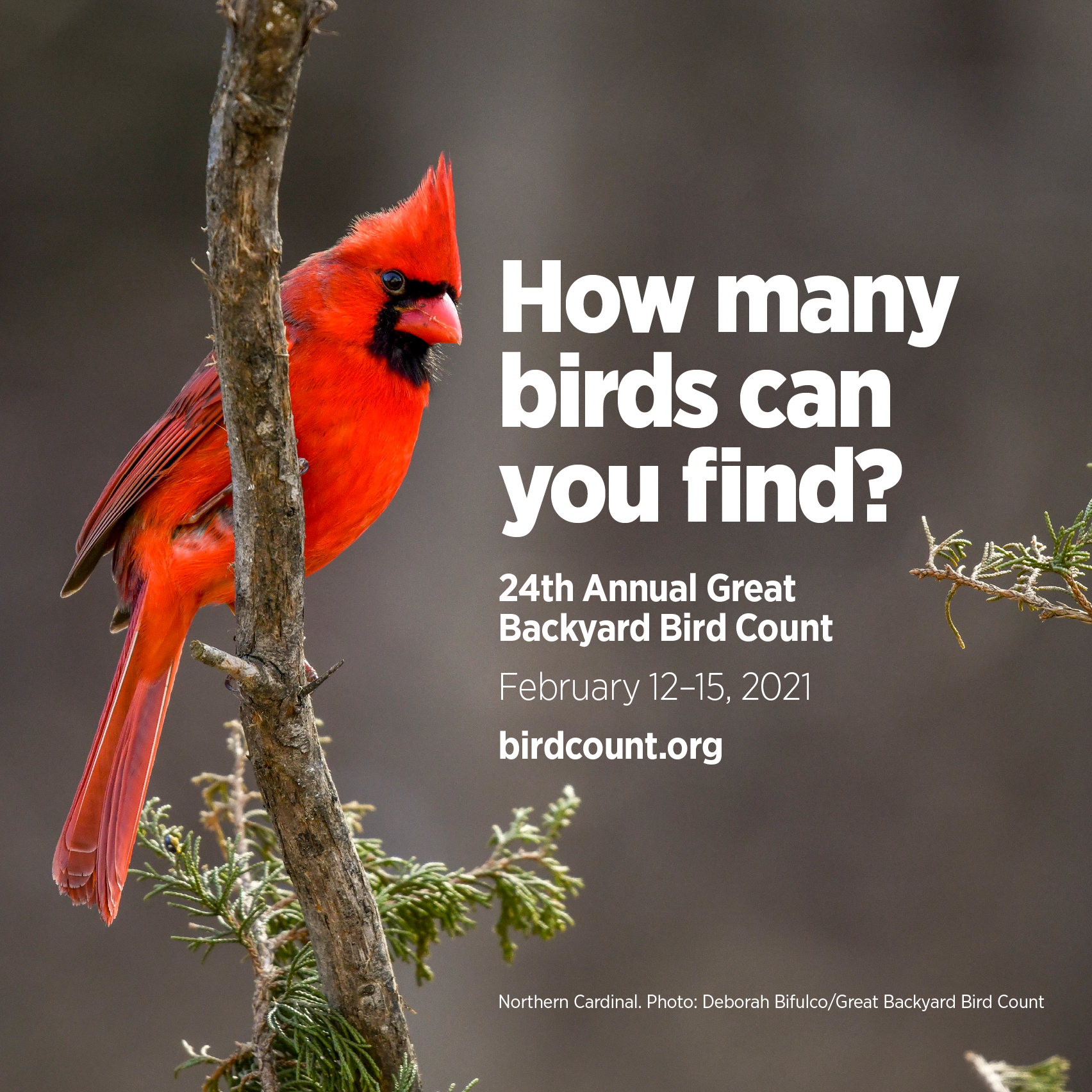
Great Backyard Bird Count

 The Great Backyard Bird Count (GBBC) is 12 - 15 February 2021. The count is an annual event, sponsored by The Cornell Lab of Ornithology, the Audubon Society, and Birds Canada. I have taken part for several years. The GBBC was launched in 1998 as a citizen science project to capture a snapshot of bird populations.

I block the mornings of these days out well in advance. I usually spend about two hours each of the mornings birding in the local parks and then some time later updating eBird with my findings. However, you can use any period of 15 minutes or more and your yard is fine, so anyone can participate. Last year, over a quarter million people around the world took part, documenting just over 6,900 species of birds.

This is a great activity to do with the kids. Since you're not required to devote a lot of time, if the kids (or your non-birding significant other) get bored, you have still contributed to our knowledge of birds.

The next Lake Arrowhead State Park bird walk occurs during the GBBC, so if you want to go with a group, plan to attend the bird walk on that date. February 13, 8:00 AM. COVID-19 safety requirements will still be in place. Currently, the requirements include no group larger than 10, social distancing, masks, and no sharing of binoculars or field guides. Those requirements may change, so check with the park the day before.

I usually publish the dates I plan to go to the various parks in case someone wants to go with me, but due to COVID-19, I am not doing that this year. However, if you would like to go, you can email me at txbirds@gmail.com--all of the COVID-19 safety requirements will be in effect, however. I plan to bird 8:00 - 10:00 each day, longer on the days I do the Wichita Bluff Nature Park segment and a portion of the Wichita Valley Rail Trail, due to the length of the trail. If I'm having a good day, I sometimes add short stops (15 - 30 minutes) at some local hot spots.

Plan to take part. If you are not already signed up with eBird, you will need to set up an account and become familiar with at least the basics to update your count information.

Good birding!


Tuesday, February 28, 2017

Reporting Out Great Backyard Bird Count

Last week concluded this year's Great Backyard Bird Count (GBBC) event. I was happy to once again be able to schedule work around participating in this event, so I got to bird four days in a row! Life doesn't get much better than that.

I have finished filing all of the GBBC checklists into eBird, so I can finally report to all of you how it went. Overall, it was pretty good weekend.

On Friday, February 17, a group of us birded the chat trail and barrow pit in Lake Wichita Park. One of our group is fairly new to birding. I enjoy having new birders in a group--it really helps to go with others when you're first learning. Sue got a lifer marsh wren. One of the highlights was a hairy woodpecker. Although you don't see one every day, I don't think most of the regular birders in the area think of them as rare, but eBird does. Several of the group independently identified the bird, but no one thought to take a picture of it, so we'll see whether they accept the sighting. We had a good morning for woodpeckers overall, with the hairy, a couple of downy woodpeckers, a northern flicker, a ladder-backed woodpecker, a northern flicker, and a red-bellied woodpecker. We didn't do as well on the duck side of the house, but a quick sighting of a great-horned owl in flight made up for the lack of ducks.
Foggy morning at Lake Arrowhead SP
Disputed sandpiper


On Saturday, a few of us tackled Lake Arrowhead State Park. Thick soupy fog made visibility poor and prevented being able to scan the lake and opposite shore for birds. Since the picture to the left was taken with my cell phone, if you haven't been to Lake Arrowhead SP, you probably don't recognize how foggy it was. From this spot, we should be able to see over the lake, but there is just a wall of white. We saw some good birds regardless. The long-eared owls were still on site. There were a lot of people who traveled from elsewhere in the state to get a good look at the owls. One is remarkably mellow about all of the coming and going. Sue King, who had the lifer marsh wren on Friday, picked up another lifer with a golden-crowned kinglet here. We spent a great deal of time studying a flock of sandpipers. To all of us the legs appeared dark and we made an identification of semipalmated sandpiper. The editor for eBird thinks the legs are yellow in the photo. We are still in discussion at this point. The list at the end of this post is accepting the sandpiper as we identified it because the legs were definitely not yellow. But the editor has only the photo and range maps to go by, and semipalmated are not supposed to be here right now. But, as the saying goes, the birds can't read the field guides. However, it is possible the sandpiper is something else, so we will see. I sent out a call to those who were there to forward any clear pictures they might have.

On Sunday, several of us met out back of Wild Bird Rescue for a GBBC in a Big Sit format. It was pretty disappointing in terms of numbers, although James got a lifer with a yellow-rumped warbler. A Bonaparte's gull and a couple of Forster's terns were highlights for me.

River up in Lucy Park
Recent rains mean quishy areas in Lucy Park
On Monday, I birded the Circle trail from the entrance of Lucy Park on Sunset Drive to Williams Park. Lucy Park is not the bird mecca it was before, but there is still some good habitat on this stretch of trail for little dickie birds. As you can see in the photos, the recent rain made much of the park pretty quishy and the river was up and moving fast. I enjoyed seeing a white-throated sparrow--the first I have seen in Lucy Park since they tore out much of the understory. However, there is still a good stand of trees and vines near the footbridge, behind the sanitation building. Down the trail some, Lynn and I saw two brown creepers, which are always a highlight for me. A surprising find in town was the pair of eastern bluebirds behind the MPEC. I have seen bluebirds a couple of times over the past 20 years in Lake Wichita Park, but never here. A belted kingfisher flying up and down the river was also nice.

I am hoping by next year's, GBBC the Nature Bluff area will be ready for visitors.

So what did we see? I am hoping I don't inadvertently leave a bird out, but here goes:

Canada goose
Double-crested cormorant
Mallard
Northern shoveler
Ruddy duck
American wigeon
American coot
Pied-billed grebe
Ring-billed gull
Bonaparte's gull
Forster's tern
White pelican
Great blue heron
Killdeer
Semipalmated sandpiper
Belted kingfisher
Great horned owl
Long-eared owl
Turkey vulture
Red-tailed hawk
Northern flicker
Ladder-backed woodpecker
Downy woodpecker
Hairy woodpecker
Red-bellied woodpecker
Inca dove
Mourning dove
Eurasian collared dove
White-winged dove
Rock pigeon
Northern cardinal
Northern mockingbird
Blue jay
Tufted titmouse (both regular and black-crested)
Eastern phoebe
Eastern bluebird
Ruby-crowned kinglet
Golden-crowned kinglet
Orange-crowned warbler
Yellow-rumped warbler
Common yellowthroat
American robin
Great-tailed grackle
Red-winged blackbird
European starling
House finch
American goldfinch
Cedar waxwing
Song sparrow
White-thrated sparrow
White-crowned sparrow
Field sparrow
Dark-eyed junco
Harris's sparrow
Brown creeper
Marsh wren
Carolina wren
Bewick's wren

If my count is correct, that's 58 species.

Good birding!

Tuesday, November 15, 2016

November Bird Walk at Lake Arrowhead State Park

Flock of pied-billed grebes
Photo courtesy of Debra Halter

Closer photo of pied-billed grebes
Photo courtesy of Debra Halter
Last Saturday was the monthly bird walk at Lake Arrowhead State Park. We had a pretty good showing, with 6 people showing up, a couple of whom are new birders. It is nice to have new people because it helps me remember to enjoy the common birds that are not so common to the beginner. The walk doesn't get advertised very well, so it is unusual to have that many people come.

I'll lead with the good stuff. We had the largest flock of pied-billed grebes any of us had ever seen. I have seen as many as 5 or 6 at a time, but this group was more like 30 in number. Debra Halter was kind enough to take some pictures as I am sure there will be some push back from the eBird editor with a number that high.

The picture above is a good view of most of the flock (yes, the two birds in the foreground are coots, not grebes.) The picture to the right is a closer look at a few of the birds to show they are definitely pied-billed grebes. These are cute little birds--always nice to see them.

The weather Saturday was absolutely gorgeous, although a little more chilly than recent temperatures--upper 40's. The winter birds are definitely beginning to show up.

Here is a complete list of the birds we saw:

Great egret
Great blue heron
Double crested cormorant
Canada goose
American coot
Pied-billed grebe
Mallard
Gadwall
White pelican
Ring-billed gull
Tern species (we couldn't get a good enough look at them to positively identify, although best guess is Forster's)
Ladder-backed woodpecker
Red-bellied woodpecker
Yellow-shafted flicker
Red-tailed hawk
Turkey vulture
Mourning dove
Northern mockingbird
American robin
Northern cardinal
Bewick's wren
Cedar waxwing
Yellow-rumped warbler
Orange-crowned warbler
Ruby-crowned kinglet
Eastern phoebe
Harris' sparrow
White-crowned sparrow
Song sparrow
House finch
Great-tailed grackle
Meadowlark species (no song)

Driving home, still in Clay County, I had a very good view of a Swainson's hawk and a couple of American kestrels.

Why not join us in December? Our next walk is December 10 at 8 AM.

Good birding!

Monday, March 21, 2016

Birding at 75+

I've been a road warrior for work lately. I've spent way too much time in the truck. As much as I like what I do, the miles on the road sometimes get to be a bit much.

When my husband is driving, it isn't too bad. He doesn't mind driving and I can look around. However, as a rule, he doesn't come with me on work trips, so I have to drive. My husband teases me when we are traveling together because I always have my binoculars at the ready and have my little notebook to record any birds I see while we are flying down the road. But he has gotten pretty good about paying attention and letting me know if we pass a county line. He thinks I am crazy to record birds by county and at high speeds, you can't really get a good look at the birds.

It was hard enough at 70 mph. Since Texas raised the speed limit to 75 (and in some places, 80 or 85), it is even more difficult, especially if you are the one driving. Nonetheless, I do try to keep an eye out for birds, while trying to be safe. I must admit my scribbles are nearly indecipherable, as I have to try to write without actually looking at my note pad.

Over the past few weeks I have put around 2000 miles on my truck, with more than that still to come over the next two weeks. I always say I am going to take time on these work trips to do a little recreational birding, but it never seems to happen that way. I am either driving there, doing my work, or driving back. I was in McAllen a couple of weeks ago and didn't bird at all--that is really sad. I have been in 28 counties over the past two weeks and expect to be several more before I wrap up at the beginning of April.

Open area and wooded lot behind the hotel in Conroe
When you are birding at a high rate of speed, you really only see the birds that are very big, very conspicuous or very common and sitting right in front of your face. If you compared my lists from one county to the next, certain birds would be on more than not. I don't think I have a single county without a turkey vulture, for example. American kestrels and mockingbirds are also on most county lists. Unfortunately, so are starlings.

Good spot for a ruby-crowned kinglet
Why keep lists by county? First, because it is a fairly small area when trying to determine a bird's range. So when you put your counts into eBird, it helps create the range maps all of us rely on. Also, the Texas Ornithological Society created the Texas Century Club some years ago to encourage people to bird some of the more remote counties and find out more about the birds found in our state. The idea was to challenge birders to find 100 birds in 100 different counties. There are some people who have managed to do that. They are more focused than I. I probably have birds in 100 counties, but no where near 100 in many of them. But I am inching my way along-it's a target to work on, but I am not competitive enough in my birding to push for it. I'll get there eventually.

Tonight I am in Conroe, TX, near the beautiful Sam Houston National Forest. I did manage a short walk near the hotel this evening, as much to stretch my legs as to look for birds, but I can multitask. The best bird was probably some eastern bluebirds, although the ruby-crowned kinglet was nice as well. I've put a couple of cell phone pictures in this post. Construction crews are busily cutting down the trees and clearing the lands for stores and hotels, so most of this will likely be gone by next year.

It just goes to show, you can enjoy birds anywhere!

Good birding!

Sunday, January 6, 2013

Birding 2013

I don't know why, but I can't help but put some significance on the first bird I see each year. It's as if I think that bird is a harbinger of the year. Intellectually I know that is not true, but that doesn't mean I don't feel that way regardless. For example, in 2011 my first bird was a house sparrow but that same day I spotted a whooping crane (a lifer), so it is demonstrably not true.

In 2012 we did the Wild Bird Rescue Big Day fundraiser and the first bird was a white-crowned sparrow, the start of a good count.

White-winged dove
Photo by Dan Pancamo via Wikimedia Commons
This year, the white-winged doves were first up. What does that say for my birding year in 2013? I must say, so far 2013 hasn't been very exciting on the birding front. However, if you want to see birds, you have to bird, and so far this year, I haven't been out much at all. But I intend to change that. I made some birding resolutions for 2013. Since I am known to be a little compulsive on my New Year's resolutions (especially after sharing them with you,) I am looking forward to a good year.

What are my birding resolutions this year?

  • Attend two birding festivals. Right now I plan for those to be the Birdfest Texoma in May and the Rio Grande Valley Birding Festival in November. If I can fit in one of the Texas Ornithological Society (TOS) meetings, I will. But the Winter and Spring meetings don't fit my schedule, so we'll see about the Fall meeting.
  • Be more consistent in keeping up this blog--in order to do that I have to get out and see some birds. I am shooting for a minimum of 1 blog post a week. I have done more than that in previous years, so it shouldn't be a problem.
  • Update my sightings in eBird regularly. I can use eBird to keep track of the birds I see. After having lost my life list not once, but twice, this is a good thing. I can't replicate those earlier records, which is discouraging, but at least I can avoid a similar disaster.
  • Add five counties to  my Texas Century Club count. This will force me to get out and bird, which is the only way to become a better birder. I am not as competitive as many people participating in this program, but I am using it as a way to encourage me to get out and bird.
I am planning for a great birding year. What are your birding resolutions this year?

Good birding!

Friday, August 27, 2010

Consider eBird

I have kept track of my sightings for years. I have also moved around a lot.

My master life list was recorded in my copy of Clements' Birds of the World--a couple of years ago that book came up missing. I am hoping the next time I move, the book will miraculously reappear, since all of my European sightings are there. My nightmare is that it was in the trunk of the car I sold a few years back, and I didn't notice when I cleaned it out. I can't imagine why that thought has been bouncing around in my head for years, but it is a recurring nightmare. It has GOT to be in this house somewhere.

I keep my field notes in little notebooks I can carry around, and some of those are missing.

I tried AviSys, but when my computer hard drive died, so did my list.

Frustrating.

I have been meaning to start using eBird for some time. My hope being that once the sightings are posted there, they cannot be lost. In addition, the information entered by birders is a source of information for many scientific studies.

eBird is another project of one of my favorite organizations, Cornell Lab of Ornithology and the Audubon Society. I am going to spend some time over the next several weeks going back through all of the notebooks I have and loading that information while inputting information from my current birding outings. Let's hope this eliminates my observation storage problem while contributing to the general knowledge about birds.

Good birding!