Showing posts with label wildlife habitat. Show all posts

Sunday, February 14, 2021

Winter Lockdown

Photo by Amanda Frank on Unsplash

It has been cold, really cold, here in Wichita Falls, and in much of the country. We are not expected to see temperatures above freezing for a week. We are also expecting a lot of snow, although there has been only a smattering of that so far. I am planning on staying in the house for the duration. Fortunately, I have an office at the house, so I can do that.

The picture to the left is not Wichita Falls and is not our Carolina Chickadee (it's a black-capped chickadee), but looks a little like our environment right now. How can such a tiny little bird, weighing only a few ounces, survive these cold temperatures?

I saw a post yesterday on Facebook where someone was asking what they could do to provide a way for the birds to keep warm. Birds are phenomenally well adapted to surviving in the cold. But there are things we can do to help. 

First, shelter. It isn't necessary to put up houses. Instead, think habitat. Trees, shrubs, vines, and grasses. These provide a windbreak and when covered with snow, can be relatively snug. Brush piles are also well-loved by small birds. With the exception of the brush piles, if you haven't already put the plants in place, you can't do much about habitat now, but you can put in some plants when we thaw out.

Extra food, especially food high in fat, is important for birds to be able to keep their body temperatures up. It takes a lot of energy to produce heat. I am going out multiple times a day to ensure there is plenty of food for all. 

Water is also important and hard for birds to find when water is frozen. Either add fresh water to the birdbath every little bit when it freezes or invest in a bubbler or heater for your birdbath.

Birds don't really need our help in the winter, but it does make us feel better to do something. Birds have some very interesting adaptations to help them survive the cold. Like what?

In the cold, birds look bigger. They fluff up their feathers. This traps air between the feathers to provide insulation between the surrounding air and their bodies. Some birds add additional feathers in their fall molt to add even more insulation. And birds add oil to their feathers as they preen.

The scales on bird legs are an adaptation that helps minimize heat loss. Birds can also control the amount of blood circulating in their legs and feet, reducing heat loss that way.

Some birds also have the ability to reduce their body temperatures in order to need less fuel. Hummingbirds do this. They have an extraordinary energy requirement, even compared to other birds. They can drop their body temperature from a normal 104 degrees F to as low as 38 degrees. Swifts and poorwills also do this.

Birds also share body heat by roosting together. Smaller birds will sometimes form piles in sheltered areas. I can remember seeing a small flock of Inca doves huddled up together in a small sheltered spot a few winters ago when we had a snowstorm.

Birds can lay down a lot of body fat in a short period of time and they will eat as much as they can in order to do so. Birds do this in the fall before migration and before winter because both require a lot of energy.

For now, keep the food out and water in the birdbath. Create a brush pile or some sort of windbreak. Plant native plants (bonus points if they provide food as well) before next winter comes.

Our birds have what it takes to survive the cold without us, but all of us can use help now and again. 

Good birding!


Tuesday, March 28, 2017

Project Feederwatch Season Nearly Over

I was updating my weekend Project Feederwatch data and noticed that next weekend is the last count for this season. Porject Feederwatch is a citizen science project, sponsored by the Cornell Lab of Ornithology. It's a good, easy project for birders of any age and ability. For home schoolers, this would be a good project to incorporate into your curriculum. For the rest of us, it's just fun. My 5-year-old granddaughter loves to feed the birds and recognizes a few of the species that come to the yard. Maybe in another year or two, she can start taking care of the recordkeeping.

I am always a little saddened by the end of Feederwatch, although I have to admit that since I moved into this house a few years ago, it also lessens my frustration level.
Male house finch, a regular at my feeders
Photo: Maria Carcacas/Project Feederwatch

This was my 19th season counting birds at my feeders. My frustration has been the lack of diversity in the birds at my feeder. This year was a little better from the point of view that on a few non-count days, I did have some nice birds in my yard. But if it weren't for white-winged doves and Eurasian collared doves, it would be pretty sparse in the bird count arena.

I think a lot of my problem is that my neighbors don't have good habitat for a variety of birds, nor do they feed birds. The yards are not huge. I have been working on my yard, adding food plants for the birds, insects, and my family. It takes a while for all of those to take hold and grow, but we're getting there. That is probably why I am beginning to see a few nice birds, even if I can't record them for this project. So, I'll keep plugging along.

I have some birding friends that also participate in Project Feederwatch. They live in a different part of town, with neighbors who feed and watch birds--they have awesome sightings. I am always jealous. But we do what we can, where we can.

I renewed my Project Feederwatch for next season. Maybe my 20th anniversary year will be "the year" my gardening work will pay off.  Why not take part in Project Feederwatch at your house next season? The season runs from November 11 to April 6 and the registration is inexpensive.

Good birding!


Thursday, April 5, 2012

Prepping for Hummingbirds


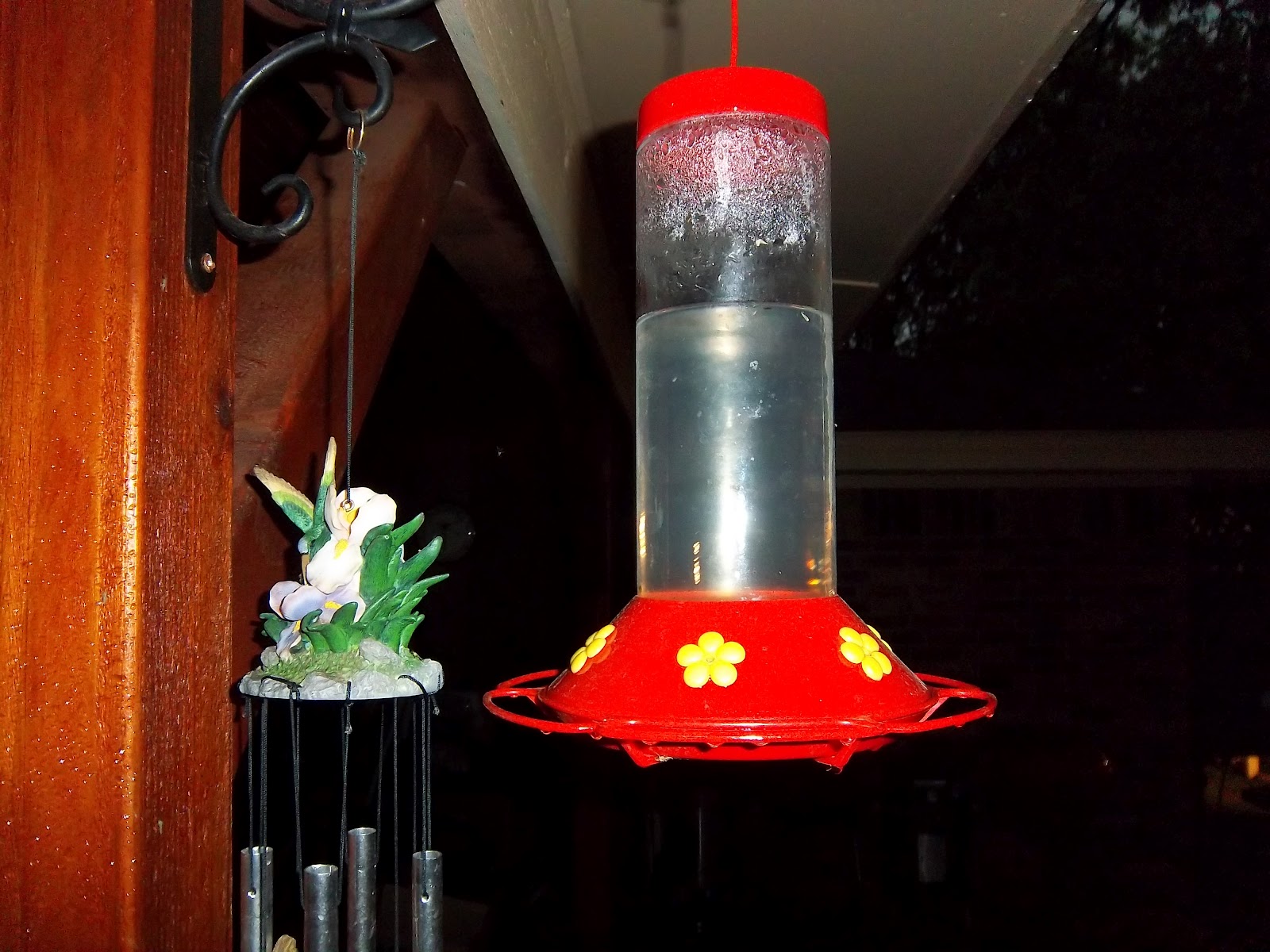
Pre-sunrise shot of hummingbird feeder.
A few folks say they have seen hummingbirds in the area. I haven't yet, but it can't be long.


As I mentioned in the previous post, I have started to change out feeders. I took down most (not all) of my seed feeders and rehung one of my hummingbird feeders. I'll get another up as soon as I see my first hummingbird.

Coral honeysuckle taking off this spring


However, whenever possible, try to supply natural food. I planted a lot of plants since we moved into our new house to encourage the hummingbirds, butterflies and pollinators. We didn't lose any plants (except perhaps the Turk's cap) during the drought. Everything is coming up this spring. My coral honeysuckles were just little twigs when I planted them next to the arbor. My husband figured they might grow to the top about the time we're eligible for Medicare. However, the plants have really taken off this spring.


Salvia is starting to bloom
It's easy and inexpensive to make your own sugar water for your hummingbird feeder, so don't by the syrup in the store. Just boil some water and mix 4 cups of water to 1 part table sugar. Stir until dissolved. Be sure to change often.,  I already had to change the sugar water in my feeder because crud was beginning to grow in it. So keep it clean and you should see some of these beautiful little birds any day!

Good birding!


Tuesday, November 8, 2011

YardMap Coming Soon

Have I said recently how much I love the Cornell Lab of Ornithology? Recently, I received an invitation to help test a new project soon to be announced from the Lab: YardMap. They picked a good person to help test because if there is anyone who can mess up something, it is me.

I have just started playing with the website, which isn't yet open to everyone, but I think it will be a fun way for those of us who are trying to improve our backyard habitat for birds to interact with others with similar interests. It will allow participants to see what others are doing and to learn from one another. I'll be sure to let you know when the application becomes available for general use.

Good birding!

YardMap Coming Soon

Have I said recently how much I love the Cornell Lab of Ornithology? Recently, I received an invitation to help test a new project soon to be announced from the Lab: YardMap. They picked a good person to help test because if there is anyone who can mess up something, it is me.

I have just started playing with the website, which isn't yet open to everyone, but I think it will be a fun way for those of us who are trying to improve our backyard habitat for birds to interact with others with similar interests to see what others are doing and to learn from one another. I'll be sure to let you know when the application becomes available for general use.

Good birding!