Showing posts with label hummingbirds. Show all posts

Wednesday, March 5, 2025

Hummingbirds Arriving Soon

Male ruby-throated hummingbird

 I haven't had a lot of luck with hummingbirds the last few years, but I get a few, so I make sure there is always a feeder with fresh nectar available.

There have been reports of hummingbirds in Austin, so they should be arriving here before too much longer. That means it is time to get out your feeders and get them cleaned up.

The picture to the left shows a common bottle-type feeder, which is fairly inexpensive.  As I rule I don't recommend them as they are difficult to clean. I had one of these and even with a bottle brush, I couldn't reach all the corners of the nectar bottle. 

A couple of things about feeders. The birds don't care if they are red. Yes, this red and yellow feeder stands out, but somehow, the hummingbirds can tell if the feeder contains the correct percentage of sugar and the nectar is fresh. To prevent ants, get a feeder with an ant moat and keep it full. To prevent bees and wasps, don't fill the feeder all the way or get one with extruders. Looking at the picture above, you can see it has deep flowers. That is intended to discourage bees and wasps, since hummingbirds have longer tongues. I personally prefer an flat feeder that is kept half full. 

Flowers are better than a feeder any day, but it never hurts to have some backup, since we tend to get some pretty hot, dry weather in the summer.

Another recommendation is not to buy nectar at the store. Plain old water and sugar is fine (and less expensive). (DO NOT use honey--this can be deadly to hummingbirds). Tap water is okay, although I do use filtered tap water. You don't have to boil the water. Hot water does make it easier to dissolve the sugar though. Use 4 parts water and one part table sugar (1 c water and 1/4 c sugar). Once the sugar is dissolved, you are ready to go. If you boil the water, let the nectar cool first before putting out the feeder. I can't imagine a hummingbird trying to drink hot sugar water, but you could be scalded if you bobble the feeder when hanging it up.

Keep your feeders clean. Bacteria grows quickly in the warm weather. I clean mine out every other day at a minimum. If you see the water getting cloudy, you definitely need to change it.

I tend to see my hummingbirds more in the early morning and at dusk. I know if the morning they are desperate to tank up. They expend a lot of energy and after several hours of no food, they are in a hurry to find food. I imagine that's why I see them just before their bedtime as well.

I hope you enjoy some hummingbirds this season.

Good birding!


Wednesday, July 24, 2024

Hummingbird Presentation Slides

At the River Bend Sip 'n Science program on hummingbirds on the 19th, some of the attendees requested a copy of the slides I used. Here is a link to those slides.

Hummingbird Presentation

Thursday, June 20, 2024

Amazing Hummingbirds!


I've never met anyone who didn't love hummingbirds. These amazing little birds are so fascinating.

If you would like to know more about these tiny birds, I will be doing an educational program at Wild Bird Rescue at noon on Thursday, June 27. The program will be about 45 minutes.

What will we talking about? We'll discuss some interesting things about this family of birds. We'll talk about how to identify the two most common species of hummingbirds in our area. Feeding hummingbirds, and what you can do to encourage hummingbirds to come to your yard

I hope to meet you then.

Good Birding!


Sunday, March 16, 2014

Hummingbirds!

OK, so I haven't seen a hummingbird yet this year, but they're coming. They have been sighted in Texas and are heading back this way. Drought conditions being what they are, some supplemental food is going to be important. I cleaned out my hummingbird feeder and set it out this morning (this picture is from last summer, not this morning.)

There is no need to spend a lot of money on nectar. You have a red feeder, the birds don't need red nectar (you don't see red nectar in your flowers, do you?) Give your wallet/purse a rest and use the following recipe: 4 parts water and 1 part sugar. You can dissolve the sugar in the water without boiling, but most of us do boil the water first--if nothing else as an extra measure to kill any bacteria that might remain in your feeder after cleaning. If you made too much, you can keep the extra in your refrigerator until you need it.

It is important you change your feeder nectar frequently--at least every 3 days. Perhaps more often in the hottest part of the summer. If the nectar looks cloudy, you definitely need to change it.

I encourage you to put out the welcome mat for your hummingbirds as soon as possible. Even if you don't see them visit, it is quite possible they are early in the morning or late in the evening. I hope however, you have the chance to enjoy these amazing little birds.

Good birding!

Thursday, April 5, 2012

Prepping for Hummingbirds


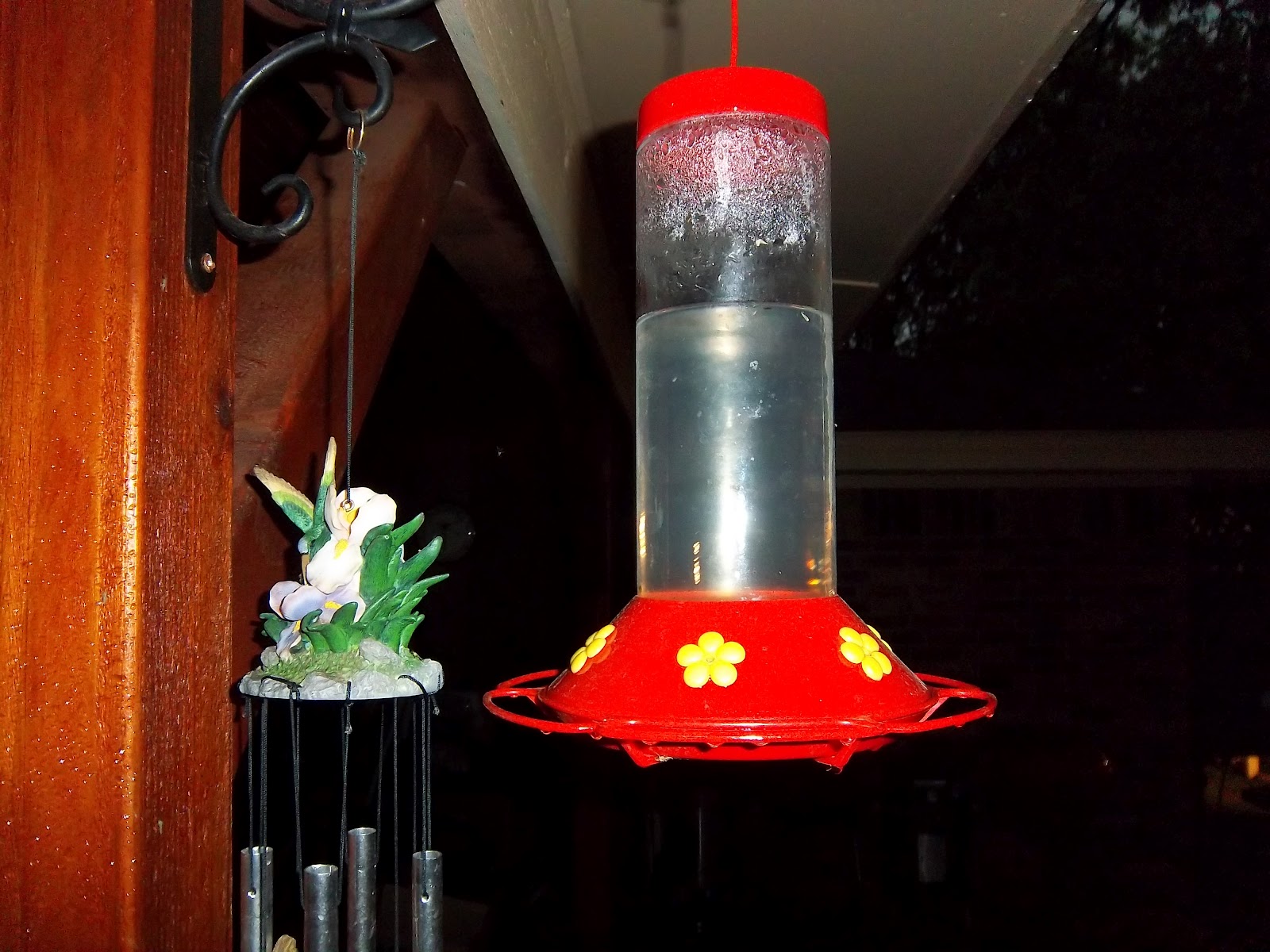
Pre-sunrise shot of hummingbird feeder.
A few folks say they have seen hummingbirds in the area. I haven't yet, but it can't be long.


As I mentioned in the previous post, I have started to change out feeders. I took down most (not all) of my seed feeders and rehung one of my hummingbird feeders. I'll get another up as soon as I see my first hummingbird.

Coral honeysuckle taking off this spring


However, whenever possible, try to supply natural food. I planted a lot of plants since we moved into our new house to encourage the hummingbirds, butterflies and pollinators. We didn't lose any plants (except perhaps the Turk's cap) during the drought. Everything is coming up this spring. My coral honeysuckles were just little twigs when I planted them next to the arbor. My husband figured they might grow to the top about the time we're eligible for Medicare. However, the plants have really taken off this spring.


Salvia is starting to bloom
It's easy and inexpensive to make your own sugar water for your hummingbird feeder, so don't by the syrup in the store. Just boil some water and mix 4 cups of water to 1 part table sugar. Stir until dissolved. Be sure to change often.,  I already had to change the sugar water in my feeder because crud was beginning to grow in it. So keep it clean and you should see some of these beautiful little birds any day!

Good birding!


Sunday, September 4, 2011

The Hawk and the Owl

Saturday morning I decided to see what the chat trail and barrow pit at Lake Wichita Park would turn up with migration underway. The weather was a muggy but bearable mid 80's, ahead of a cold front and cooler weather (hallelujah!)

I was very happy to see a little blue-gray gnatcatcher along the chat trail. I haven't seen a lot of these little guys in town, but when I do come across one, it is almost always along the chat trail. A little further along the trail, seven white-faced ibis flew over my head, calling, on their way to the barrow pit.

The barrow pit still has some pools of water, so there were birds, to include the usual peeps I couldn't positively identify. But as I was watching the white-faced ibis and black-necked stilts, a small flock of 11 American avocets circled the barrow pit and landed. They stayed for all of maybe two minutes before heading out to Lake Wichita. They are very pretty birds that migrate through in the spring and fall. In addition to the mallards, blue-winged teal and the redhead ducks that are usually there, a small group of 8 northen pintails were dabbling in one of the pools. It is a little bit earlier than usual to see these ducks, but not by a lot. They are such an elegant duck--one of my favorites.

Throughout my time in park, I kept hearing a red-tailed hawk in several locations. I didn't see him, but periodically heard him calling. On my way back to my truck I heard him again near the chat trail, so looked into some nearby trees to see if I could locate him. I checked out a tree based upon where it sounded like the call was coming from and saw what sure looked like a great horned owl. I couldn't see the head clearly, but the stocky build of the great horned owl is distinctive and not at all like the sleeker build of the red-tailed hawk. But I could hear the red-tailed hawk cry right in the same area. While I was trying to decide if I was trying to turn a red-tailed hawk into a great horned owl, the owl (seemingly irritated by the constant calling of the red-tail) flushed from the tree. A couple of seconds later, the red-tailed hawk flew in pursuit. All I have to say after being around both is that the red-tailed hawk had better hope the great horned owl didn't turn on him--he'd be toast.

The warblers are coming through with a few black-and-white warblers and several yellow warblers along the chat trail. I was also fortunate to get some good views of a hairy woodpecker (I've always wondered, why "hairy?"). There was also a single purple martin soaring overhead--I haven't seen any purple martins in a couple of weeks.

Before going home, I drove to the other side of Lake Wichita to the spillway to see if there was anything special there. With no water going over the spillway, I didn't expect much and didn't get it. A few snowy egret and a greater yellowlegs was about it, although there was a fairly good bunch of killdeer as well.

When I got back to the house, I was pleased to see some black-chinned hummingbirds at the feeder. I think anyone who has a stocked hummingbird feeder is going to see hummingbirds this fall.

Overall a good morning. I am looking forward to the Labor Day holiday. The weather is supposed to be much cooler with a cold front coming through. Fronts usually bring along a good bunch of migrants, so I plan to be out looking for them.

Good birding!

Monday, August 29, 2011

Help Migrating Hummingbirds

Hummingbird migration has started and with the drought, the little guys will depend even more on our feeders than usual.Photo above is of a patient at Wild Bird Rescue, so you can see how tiny they are.

I had the opportunity to do a short interview for Channel 6 today to talk about the impact of the drought on hummingbirds in migration. The segment may air tomorrow, depending upon other news. If you get a chance to watch, don't tell me. I try never to watch myself on TV.

Anyway, that made me think this would be an ideal time to talk about hummingbirds. We have black-chinned hummingbirds and ruby-throated hummingbirds here in the summer. During migration in September and October, other species of hummingbird may pass through, although not in large numbers.

All birds use a lot of energy in migration--hummingbirds are no exception. They consume a lot of food to keep their energy levels high for the trip to central America. They eat primarily nectar in flowering plants as well as small insects. With the severe drought there is a scarcity of flowering plants and the insects have not been plentiful either. This year more than most, hummingbirds will need the extra food provided by those of us who hang out hummingbird feeders.

If you don't already have feeders out, this would be a good time. You can make your own sugar water cheaply by mixing 1 part cane sugar with 4 parts water and boiling. Let the sugar water cool and pour it into a clean feeder. It is important to keep the nectar clean. Usually, you should clean out the feeder every 3 days, but in this heat, you may need to change the sugar water daily. If you see any cloudiness then change the water right away.

Hang the feeder out of the sun and preferably where the birds have a view of the sky. For best results, place your feeder near other flowering plants (if you have any.)

Let's help these wonderful birds have a safe trip.

Good birding!

Friday, May 27, 2011

Why Birds?


Left: Ruby-throated hummingbird patient at Wild Bird Rescue.


Last night I was at a dinner and someone asked me, "What is interesting about birdwatching?" I did a poor job of answering the question, in part because I did not want to get cranked up and talk too long, as I can be prone to do on one of my favorite topics.


I like to use the ruby-throated hummingbird as an example of why birds are so interesting. If you will hold in your hand 4 cotton balls, you can feel the approximate weight of a full-grown hummingbird. The bird itself is about the size of one of those cotton balls. Now that you have an idea of how small and delicate one of these little guys is, imagine that bird flying 600 miles non-stop over the Gulf of Mexico on migration--18 hours.


We think of flight when we think of birds, although not all birds fly. There are a number of physiological adaptations in addition to the anatomical ones that make flight possible. Flying uses a lot of energy and the muscles have to be well oxygenated. Consequently, oxygen has to be carried by the blood in large amounts. A hummingbird at rest has a heart rate of about 250 beats per minutes, which can rise to 1200 beats per minute in flight--the aveerage heart rate for humans is 70 beats per minute.


Not only does the heart beat fast but the heart empties entirely with each heartbeat. Our heart always has some blood in it. The amount of pressire required to empty the heart is substantial--therefore, birds have high blood pressure, making them susceptible to heart attacks. In rehab, we have to be careful about stress on birds that already have health issues when they are brought in. It is common for birds to "faint," and occasionally die from a heart attack when stressed.


This is just one example of the thousands why birdwatching is constantly interesting. Although all of nature provides similar fascinating stories, birds can be watched anywhere, anytime, by anyone, making it an accessible and low cost hobby--well, low cost if you can avoid all the cool gadgets, interesting books, trips and other fun things that you can get to help you enjoy the hobby more.


Good birding!

Friday, March 25, 2011

Time to Get Your Hummingbird Feeders Ready


Tiny patient at Wild Bird Rescue (left)


Hummingbirds are moving back into Texas. The reports on TEXBIRDS have been getting closer by the day. This morning I saw a post of a black-chinned in Weatherford, so they should be arriving here within days. The ruby-throated hummingbirds are usually a couple of weeks behind.

Although plantings of native flowering plants is the best option for attracting these tiny birds, many of us also like to attract them to areas we can watch them with feeders. If that's the case for you, it's time to get your hummingbird feeders ready to go. Make sure they are clean. Plain soap and water works. I used to get really frustrated trying to make sure all the little crevices and tiny holes were clean until I happened upon this little trick--use Efferdent tablets. They are very helpful in cleaning tiny areas. You can also use vinegar and baking soda mix (just like unplugging your drains.)

Don't buy commercial nectar. It is expensive and has red dye. The red in the feeders is enough to attract the birds. They could care less what the nectar looks like--you don't see red nectar in flowers, do you? To make your own nectar much more cheaply, mix 1 c water and 1/4 c granulated sugar. You can stir until the sugar is dissolved--I usually boil the water, stir in the sugar and then let it cool. The sugar dissolves more quickly and thoroughly in hot water. If you make more nectar than your feeder holds, you can put the sugar water in a covered container and store it in the refrigerator for a few days.

You should dump any nectar in your feeder every few days. You will need to do it more often when it is hot than when the temperatures are moderate. Always clean out your feeders if you see any cloudiness.

When you place your feeders, hang them close to cover (trees and shrubs) but not under an overhang. Hummingbirds generally shoot up when startled by predators and prefer to see open sky above the feeders.

So get out your feeders and get ready to enjoy these beautiful and interesting birds.

Good birding!

Wednesday, January 19, 2011

Want to Learn More About Photographing Hummingbirds?

Want to learn more about photographing hummingbirds? The local photography club will be hosting a program on just that topic on Tuesday, February 8, 7 PM at the Kemp Center for the Arts. No RSVP is required; just show up. For more information, contact Terry McKee at dgm59@aol.com.

Good birding!

Friday, November 26, 2010

Hummingbirds in the Snow

Although a few records exist of ruby-throated hummingbirds in our area into December, as a rule, all of our hummingbirds are gone by mid-October. Their food isn't present in abundance and they go torpid in the cold--which can't be good for avoiding predators.

But as all birders know, birds don't necessarily do the things we expect. I am providing a link, sent to me by Elizabeth Hawley with some photos of hummingbirds at feeders in the snow. But you can see that the photographer made some effort to make things more hummingbird friendly by supplying cover and a heat source.

Good birding!

Tuesday, May 25, 2010

I Love NPR

Great documentary on hummingbirds you can watch online. If you have a spare 50 minutes, learn more about these fascinating little birds.

Good birding!

Wednesday, January 6, 2010

PBS Program on Hummingbirds

KERA's schedule shows a program on hummingbirds Sunday, January 10 at 7 PM.

Good birding!

Tuesday, November 3, 2009

Super Film Clip of Hummingbird

OK, this is not a bird in/around Wichita Falls, TX, but it is so neat, I had to share. I love David Attenborough's programs on the BBC. This looks like it will be another hit.

http://news.bbc.co.uk/earth/hi/earth_news/newsid_8338000/8338728.stm

Good birding!

Tuesday, July 21, 2009

Bird Club Tonight

I don't know why I never post before the day of the meeting, but that's the way it is.

The North Texas Bird and Wildlife Club meets tonight at 7:00 PM at the NALC Building on Southwest Parkway (next to Wichita Valley Nursery, between Cypress and Barnett.) Terry McKee will give a program on hummingbird migration.

Good birding!

Monday, April 20, 2009

FOS Western Kingbird and Hummingbird

I saw my first Western Kingbird of the spring on a wire in Wichita Falls today. There was only the one. As usual, the scissortails are far more numerous. I also saw my first hummingbird of the season checking out the feeder at Wild Bird Rescue. Although the feeder was empty, the red sage is in bloom. If was in and out so fast, I wasn't able to tell if it was a ruby throat or a black chinned.

Good birding!

Monday, September 15, 2008

Cool Stuff About Hummingbirds

Hummingbirds are fascinating. They are probably the bird I get the most questions about and the bird I am asked to give the most presentations about. Since hummers seem to be on everyone's mind since they are present in large numbers right now, I thought it would be a good time to post a few interesting things about them.
- In flight, a hummingbird's heart rate exceeds 1200 beats per minute
- Hummingbirds can enter a state of stupor to survive cold weather, and their heart rate may drop to 50 beats a minute and they may not breath for long periods of time
- Hummingbirds are the only birds which can fly backwards
- Many ruby-throated hummingbirds cross 500 - 600 miles of open water
- Hummingbirds are polygamous and dad does not contribute to raising his babies

If you love hummingbirds, you should love spiders. Not only are small spiders prey for hummingbirds, but hummingbirds will pick small insects out of a spider's web and use spider silk to build their nests. Some larger spiders can eat hummingbirds, however. Other hummingbird predators include cats, shrikes, roadrunners, and large frogs.

If you have ever had a humimngbird in hand, you would be absolutely amazed that a bird so tiny is so hardy and resilient. Truly a miracle.

Hummingbirds on the Move!

Beverly McClure posted a comment to the last blog about the wrens, commenting on the increased numbers of hummingbirds in her yard over the past several days. I also received an email from a fellow volunteer at Wild Bird Rescue that she had 10 - 12 hummingbirds at her feeders this past week. It's that time; the hummers are on the move to their winter homes.

Here in Wichita Falls, we normally have 2 species of hummingbirds in the summer--the ruby-throated and the black-chinned. However, during fall migration other species may show up. So keep your cameras handy.

It is important to leave up your feeders during this time and leave your flowering plants (don't cut them down) so these little guys can tank up. Many of them fly over the Gulf of Mexico for several hundred miles without a stop and need the extra calories.

Please post if you have any interesting sitings.

Monday, September 1, 2008

Texoma Water Garden Society

Thursday I had the pleasure of speaking to the Texoma Water Garden Society. I have thought about joining this group several times. There are several people I know and like in the club, and I have wanted a pond for years. But at present a pond is not in the cards, and I need another meeting to attend like I need another animal in the house. But they asked me to come talk to them about birds, so of course I said yes.

Initially, Marjorie asked me to talk about hummingbirds. Then she asked if I could also share some information about the Mississippi Kite.

The group meets in the backyards of its members, so everyone can see their ponds. The hosts this month had a beautiful yard. Everyone brought food. The group was gracious and had a lot of questions. Many have hummingbird feeders in their yards and flowering plants to attract these beautiful little birds, so were already interested in the topic--sure makes it easier on a speaker that way.

All in all, a great time for me. I didn't notice anyone dozing, so I assume my presentation was at least short enough to keep them from nodding off.