Thursday, April 5, 2012

Prepping for Hummingbirds


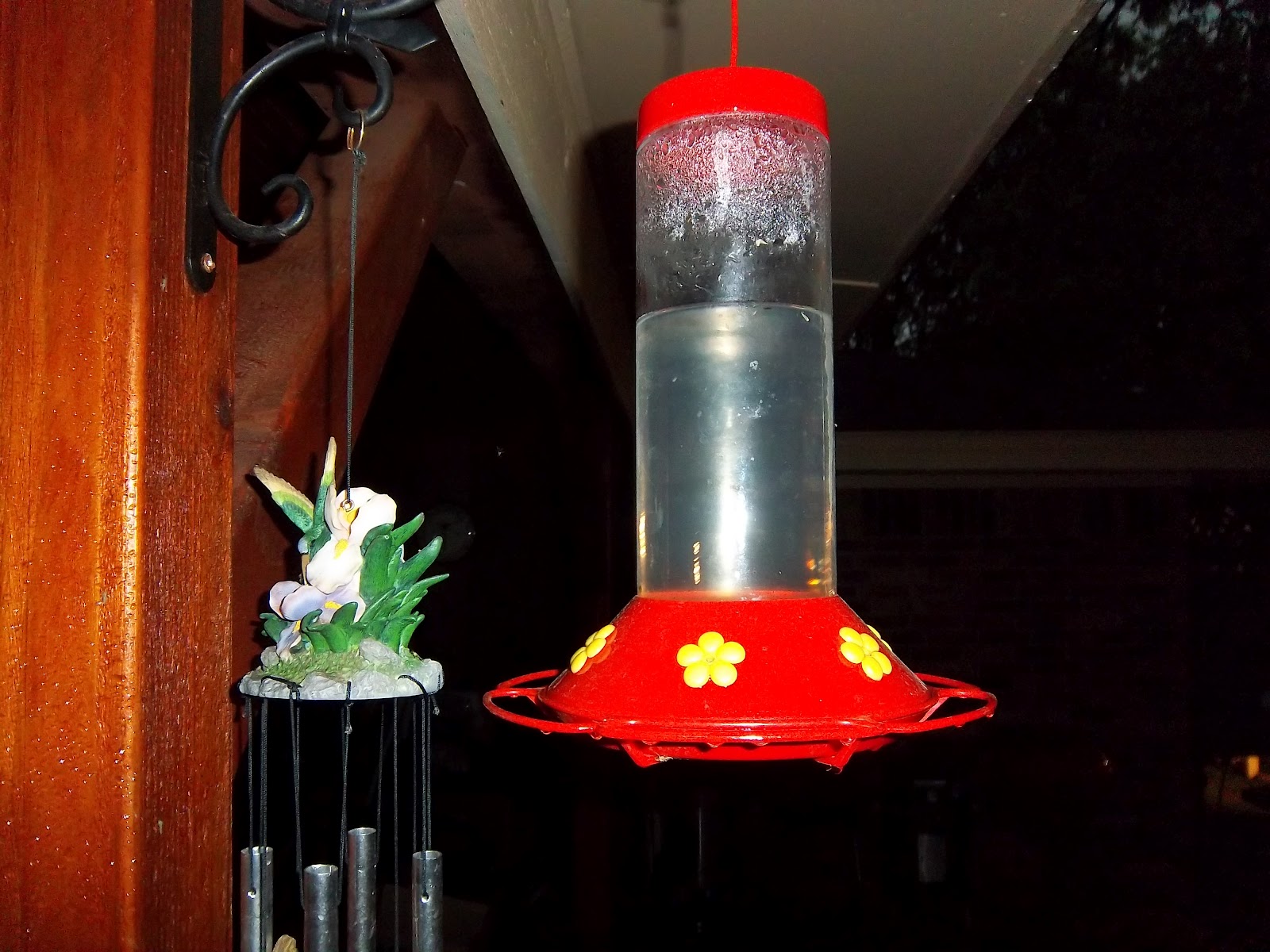
Pre-sunrise shot of hummingbird feeder.
A few folks say they have seen hummingbirds in the area. I haven't yet, but it can't be long.


As I mentioned in the previous post, I have started to change out feeders. I took down most (not all) of my seed feeders and rehung one of my hummingbird feeders. I'll get another up as soon as I see my first hummingbird.

Coral honeysuckle taking off this spring


However, whenever possible, try to supply natural food. I planted a lot of plants since we moved into our new house to encourage the hummingbirds, butterflies and pollinators. We didn't lose any plants (except perhaps the Turk's cap) during the drought. Everything is coming up this spring. My coral honeysuckles were just little twigs when I planted them next to the arbor. My husband figured they might grow to the top about the time we're eligible for Medicare. However, the plants have really taken off this spring.


Salvia is starting to bloom
It's easy and inexpensive to make your own sugar water for your hummingbird feeder, so don't by the syrup in the store. Just boil some water and mix 4 cups of water to 1 part table sugar. Stir until dissolved. Be sure to change often.,  I already had to change the sugar water in my feeder because crud was beginning to grow in it. So keep it clean and you should see some of these beautiful little birds any day!

Good birding!


Wednesday, April 4, 2012

Project Feederwatch Year End

One set of feeders out back.


This past weekend was my last count for Project Feederwatch. Since  my winter feeder birds are gone and the numbers of birds visiting the feeders is down, I guess it's time.

I am swapping out my feeders for the summer. I feed all year; I just don't feed as much and I switch up the food. Over the summer, I'll have the two tray feeders, the hummingbird feeders and the mealworm feeder. I should have the changes all made by this weekend.

If you can, consider joining Project Feederwatch next year. The season starts in November, but be sure to sign up early so you receive your materials in time.

Good birding!

Sunday, April 1, 2012

Texas Ornithological Society Spring Meeting

The Texas Ornithological Society (TOS) will hold its spring meeting in Port Aransas, May 3 - 6. I am planning to go. I've sent in my registration form, so I am committed to it now. I have only gone to one other TOS meeting, and that was a few years ago. They always come at a bad time for me.

In addition to some awesome field trips at a perfect time of year for migrants, a special treat will be a fundraiser for the TOS Sanctuaries Fund. A group of grade school kids is going to do a mini Big Day to raise money. You can make a pledge here.

It should be a good time, with the promise of some great birds as well. If anyone from this area wants to go, contact me at txbirds@gmail.com and perhaps we can carpool.

Good birding!

Book Review: How to Be a Better Birder

Princeton University Press sent me a sweet little volume, How to Be a Better Birder, by Derek Lovitch. At first glance, I thought it might be a rehash of some other books on bird identification using the "whole bird" concept versus relying upon field marks. And the book does have some discussion on that point, although Lovitch pays homage to several of those other books in his first chapter.

I have been fortunate for the past few years to teach the basic birding class for the Rolling Plains Texas Master Naturalist training class. My approach to teaching identification starts with "when and where" and proceeds through a list of items to consider, that includes color and field marks. However, I try to downplay those items as most birders, especially novices, place too much emphasis on only them, to their detriment.  Lovitch has a chapter on "Birding by Habitat" as well. His discussions of geography and weather and their impact on seeing the most birds, especially during migration, were especially interesting. I have been working on my sparrow identification skills for some time--his short section on why this group of birds shouldn't intimidate birders was very useful.

However, one of the unique aspects of the book is how technology can make you a better birder. I always wondered about the interest in the radar images of night migration and just how useful that could be to the average birder, but Lovitch explains this, and I will definitely pay more attention in the future.

As I am involved in several citizen science projects about birds, I was glad to see a chapter on how birders can put the observations to use in helping capture knowledge about birds that can postively impact their conservation.

Derek Lovitch's advice on how to be a better birder? Go birding! I wholeheartedly agree.

Birders at any experience level will find something of interest in this slender volume. The book is available from your local bookstore for $19.95 or from Amazon for $13.23.

Good birding!

Wednesday, March 28, 2012

Bluebird Buddy Box Check

Saturday morning was absolutely gorgeous. As I mentioned in a previous post, the Friends of Lake Arrowhead State Park have a Bluebird Buddy program. Individuals or groups can sponsor a bluebird box for $50 a year.
Greg, Larry and Terry check out one of
the bluebird boxes at LASP.


Me with my bluebird box--empty so far.


Saturday Greg Mucciolo, Terry McKee, Larry Snyder and I visited 15 boxes to affix sponsor names, get GPS coordinates for each box and check the status of nesting. We found one box with newly hatched bluebird chicks, 3 with wren nests and several with wasps.  You too can find your bluebird box with the GPS coordinates. Terry is emailing each sponsor updates on the nesting activity in their box.

Greg has maintained the boxes at the park and other locations for several years. He will be returning to soap the inside of the boxes with Ivory soap to discourage the wasps--birds can't use them when they are full of these stinging critters. The Ivory soap is nontoxic but makes the surface so that the wasps cannot affix their nest to the wood, so they leave to find other accommodations.
Lots of gorgeous wildflowers at LASP
While we were checking the boxes, we saw some glorious wildflowers and did manage to see a few birds including: killdeer, Harris's sparrow, northern mockingbird, western meadowlark, song sparrow, ladderbacked woodpecker, northern cardinal, Carolina chickadee, mallard, American robin, eastern bluebird, turkey vulture, eastern phoebe, house finch, white-crowned sparrow, red-tailed hawk, savannah sparrow, white pelican, Canada goose, red-winged blackbird, European starling, and red-bellied woodpecker. On 1954 outside LASP we saw some gadwall in a tank.

This is a great spring for getting outside, so take advantage before the summer heat sets in.

Good birding!


Saturday, March 17, 2012

Hummingbirds/Purple Martins

Purple martins by Dori, Wikimedia Commons
Hummingbirds and purple martins are arriving. Purple martins have been reported all around and even north of us. If you have a purple martin house, be sure to evict the starlings and house sparrows and keep them out until the martins arrive.

For those who love the hummingbirds, it's time to clean out your feeders and get them up. Our most common hummingbirds in this area are the ruby-throated and black-chinned hummingbirds. They are very similar in appearance. Appropriate native plants are the most important food source you can make available to these tiny birds with a big attitude. If you haven't already done so, head to your local nursery and pick up some hummingbird friendly plants--coral honeysuckle, crossvine, sage, etc.

Ruby-throated hummingbird, William H. Majoros
Used by permission, Wikimedia Commons
If you don't have the space or ability to garden or just want to draw the birds to a place you can more easily watch them, hang a hummingbird feeder or two or more. It is very important the feeder be kept clean. You do not have to buy expensive hummingbird nectar. Just dissolve 1 part white sugar in 4 parts boiling water, allow to cool and pour into your feeder. You do not have to color the water red--and in fact, most people advise against it. If there is some red on the feeder, the birds will find it easily.

Be sure to change the water regularly and clean the feeder thoroughly each time. Never allow your water to get cloudy. Right now, with the cooler weather, you can probably leave your sugar water up to three days. When it gets really hot, you will probably want to change it every day.

I hope you are able to attract and enjoy these beautiful birds this summer.

Good birding!

Saturday, March 10, 2012

Bird Walk at Lake Arrowhead State Park

The first bird walk at Lake Arrowhead State Park was this morning. The rain was kind enough to hold off until around lunch, so it was a decent morning although overcast. We didn't see a lot of birds, but it was still a nice time.

The only other person who came was Mike, one of the readers of this blog. We had a nice walk of a little over an hour. The Bewick's wrens were singing all over. We are on the border between the eastern and western meadowlark territories. I tend to see/hear more eastern meadowlarks. Today the meadowlarks were singing and they were westerns.

We saw: northern cardinal, eastern phoebe, Canada goose, American coot, white pelican, great blue heron, northern mockingbird, mourning dove, Eurasian collared dove, western meadowlark, Bewick's wren, red-winged blackbird, northern flicker, white-crowned sparrow, field sparrow, great-tailed grackle, common grackle, killdeer, double-crested cormorant and red-bellied woodpecker. We also saw a duck species, some gulls and some small peeps--all were too far away and in too poor light to make a positive ID.

After Mike and I split up--he to visit the prairie dogs and I to do a little more birding--I went over to the area around the equestrian camping area. I had some good luck there, adding robin, kestrel, dark-eyed junco, house finch, Carolina chickadee, eastern bluebird, and ladder-backed woodpecker. 


I didn't get any decent pictures of the birds, although perhaps Mike did. I did get more next pictures to add to my collection as well as this nice picture of one of the prairie dogs (right) and a pretty wildflower (left)--I have not idea what kind it is, but it was interesting, so I took a photo.

We'll be continuing the bird walks on the second Saturday of each month. We start the summer schedule in April, so the walk will start at 7 AM.

Good birding!